Inlay/Onlay Restoration
A restoration made outside the mouth is fitted into the tooth defect to restore shape and function. It is a minimally invasive restoration superior to traditional filling in suitable cases.
An inlay is a restoration inserted into a tooth to restore the shape and function of a defect. Inlay restoration is made outside the mouth, by a dental laboratory or computer-aided design/manufacturing, and then bonded to the defect. Compared with traditional resin or amalgam fillings, it offers better marginal fit, mechanical properties, and proximal contact recovery. Depending on coverage, restorations are divided into inlays and onlays. An inlay fits inside the defect and does not cover cusps; an onlay covers some or all cusps and is suitable for larger defects. Materials include ceramic, resin, and metal, with ceramic inlays offering both esthetics and strength and commonly used for posterior restoration. Strict bonding protocols are required, and treatment usually needs 2 visits.
Quick Reference
Treatment
1 hours – 2 hours
Observation
0 mins – 1 days
Est. Cost
$100 – $900
Department
Prosthodontics
Who Is This For
Is Inlay/Onlay Restoration Right for You?
Good Candidates
- Posterior teeth, premolars or molars, with relatively large defects where traditional filling cannot provide good retention or proximal contact
- Coronal restoration after root canal treatment in posterior teeth, possibly with an onlay
- Repeated loss of old fillings or secondary caries
- High esthetic demand for the restoration, such as choosing ceramic inlay
- Enough remaining tooth structure to support the restoration
May Not Be Suitable
- Very large tooth defect with insufficient remaining tooth structure to support inlay retention, requiring full crown restoration
- Active caries not completely removed, untreated pulpitis, or untreated periapical periodontitis
- Severe sleep bruxism or excessive bite force
- Very poor oral hygiene with high caries activity
- Allergy to restorative materials
Step-by-Step Process
How Inlay/Onlay Restoration Works
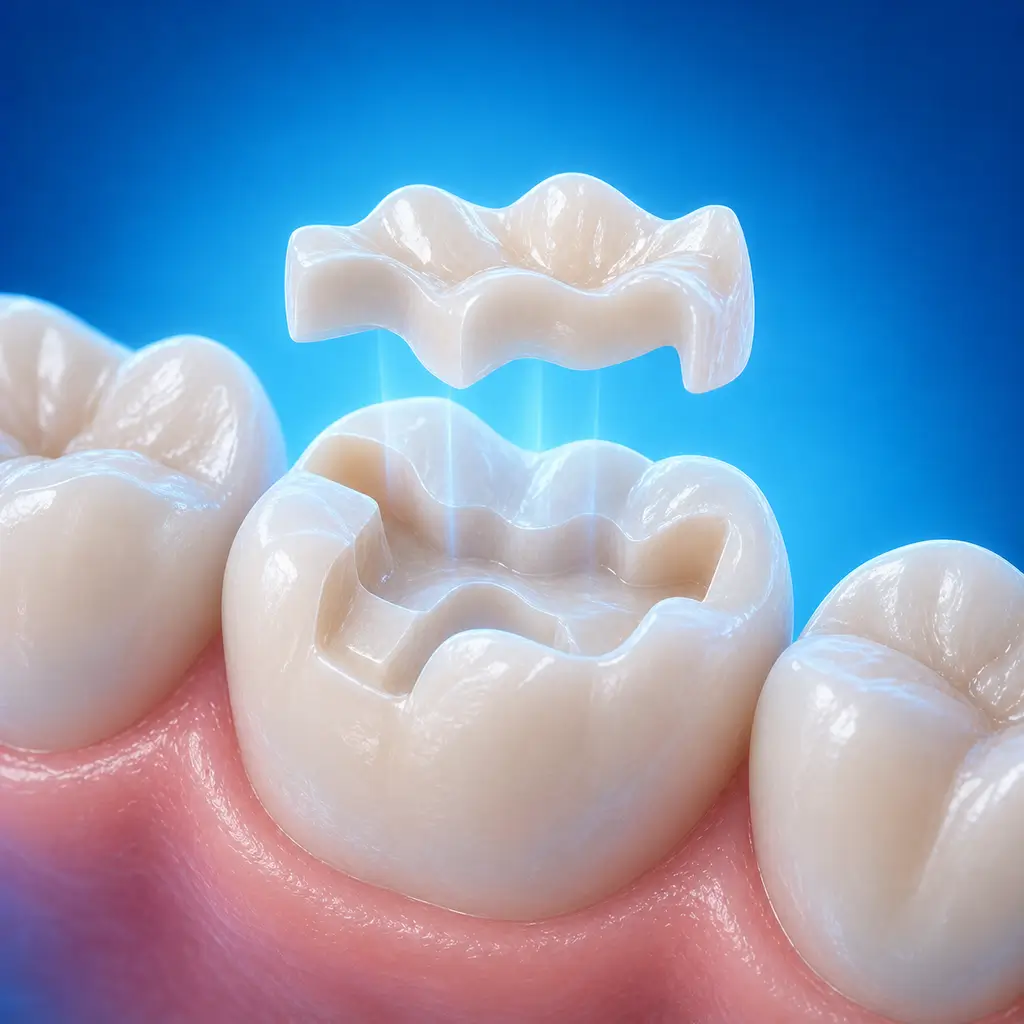
Tooth Preparation and Impression
Caries and old filling material are removed, and an inlay cavity form is prepared, such as box form and dovetail retention, with cavity walls diverging about 6 degrees.
Tooth Preparation and Impression
For onlays, about 2 mm of space is reserved for cusp coverage. After gingival retraction, a silicone impression or intraoral scan is taken to obtain a digital impression, and a temporary inlay is made to protect the tooth and maintain proximal contact and occlusion.
Laboratory Fabrication Between Visits
The model is sent to the dental laboratory to fabricate the inlay, taking about 1-2 weeks.
Same-day Digital Fabrication
Digital restoration can be completed on the same day.
Try-in and Bonding
The temporary inlay is removed and the tooth is cleaned. The inlay is tried in to check marginal fit, proximal contact, and occlusal contact. Before bonding, the tooth is etched and adhesive is applied.
Try-in Bonding
Ceramic inlays also require hydrofluoric acid etching and silanization. Resin cement is used for bonding and light curing, excess cement is removed, occlusal high spots are adjusted, and polishing is performed.
Review and Maintenance
Regular follow-up evaluates marginal fit and proximal contacts.
Usually 2 visits are needed, about 1-2 weeks apart. Digital inlays can be completed in 1 visit when conditions are suitable, taking about 2-3 hours.
Cost Information
Cost Estimate for Inlay/Onlay Restoration
Estimated Price Range
$100 – $900
What's Included
Digital or plaster models, tooth preparation, materials such as resin, pressed ceramic, or zirconia, fabrication method, traditional or digital, and bonding.
Before Your Visit
What to Prepare
Required Tests & Examinations
If you already have recent valid test results, bring the reports. If not, these assessments can usually be completed in China before the procedure.
Clinical oral examination: assess tooth defect extent, depth, remaining tooth structure thickness, occlusion, and periodontal status
X-ray examination: assess caries depth, pulp status, periapical lesions, and proximal contacts
Pulp vitality testing to determine pulp status and whether root canal treatment is needed
Impression or intraoral scan to make study models and analyze occlusion and proximal relationships
Documents & Materials to Bring
Required to Bring
Recent dental imaging, such as periapical radiograph, bitewing, or CBCT if available
Previous dental treatment records, especially filling, root canal treatment, or crown restoration records
Existing restoration or occlusion-related materials if available
Medication allergy history
General medical history information
Companion & Support
A dedicated companion is usually not needed. For children, older adults, pregnancy, underlying medical conditions, or when treatment may affect eating or travel afterward, having a family member accompany the patient is recommended.
After Treatment
Recovery & Follow-Up
Avoid chewing with the restored side for 24 hours after bonding.
Avoid biting hard objects with the restored tooth, such as bones, nuts, or crab shells.
Maintain oral hygiene and use floss to clean interdental spaces around the inlay to prevent secondary caries.
Attend regular follow-up to check marginal fit and damage.
Follow-Up Schedule
Review occlusion and proximal contacts about 1 week after treatment, then regular follow-up every 6-12 months.
Related Conditions
Conditions This Procedure Treats
Ready to Plan Inlay/Onlay Restoration in China?
Let Carevia help you find the right hospital, coordinate your treatment, and arrange every detail of your medical trip.
Frequently Asked Questions
Need personalized guidance?
Our care coordinators can help you assess whether this procedure fits your situation.
Contact Us