Trifocal IOL Implantation
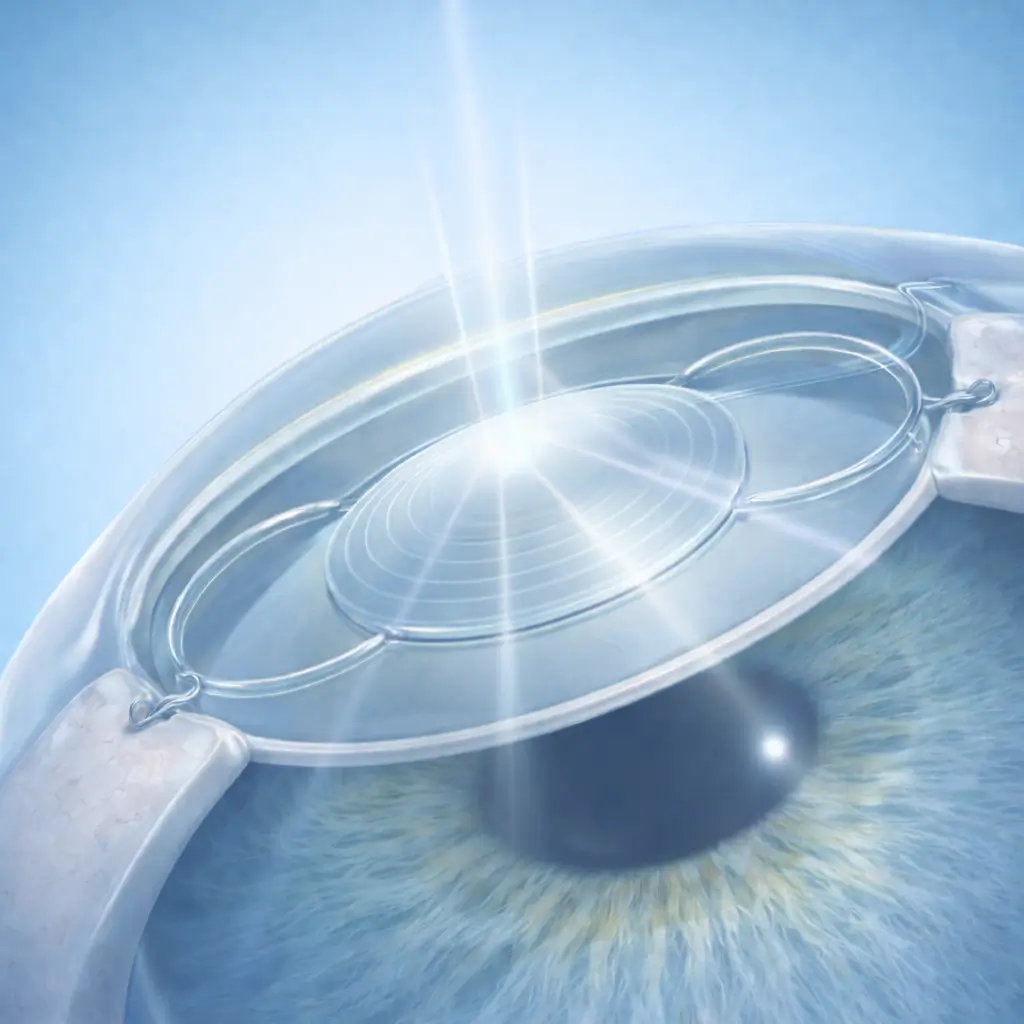
After careful selection, implantation of a trifocal intraocular lens can reduce spectacle dependence in patients with presbyopia and cataracts while balancing far, intermediate, and near vision.
The surgical procedure is broadly the same as standard cataract phacoemulsification, except that a presbyopia-correcting trifocal diffractive IOL is implanted (for example, Zeiss AT LISA tri or Alcon PanOptix). These lenses can help balance far, intermediate, and near vision and reduce dependence on glasses, but they do not guarantee complete spectacle independence for every patient. Outcomes are influenced by corneal astigmatism, ocular surface status, macular function, residual refractive error, and neural adaptation. This option is best suited to carefully selected middle-aged or older patients with presbyopia and early cataract.
Quick Reference
Treatment
15 mins – 45 mins
Observation
1 days – 3 days
Est. Cost
$3,700 – $9,700
Department
Ophthalmology
Who Is This For
Is Trifocal IOL Implantation Right for You?
Good Candidates
- Middle-aged and older patients with presbyopia and cataracts who pass careful preoperative screening
- Those with strong desire for spectacle independence
- People frequently switching between far, intermediate, and near distances
- Active individuals with high quality-of-life expectations
May Not Be Suitable
- Significant uncorrected astigmatism >1.5D (toric trifocal needed)
- Severe fundus disease affecting vision
- Extreme sensitivity to halos or very high night driving demands
- Pupil too large or too small
Step-by-Step Process
How Trifocal IOL Implantation Works
Preoperative preparation
Pupil dilation, topical anesthesia, sterile draping.
Corneal incision
Create a 2.2-2.4mm clear corneal incision.
Capsulorhexis and hydrodissection
Continuous curvilinear capsulorhexis and hydrodissection to mobilize the lens nucleus.
Phacoemulsification
Ultrasonic emulsification and aspiration of the cloudy or clear lens.
Trifocal IOL implantation
Inject the folded trifocal IOL into the capsular bag and adjust position.
Completion
Irrigate residual cortex, hydrate wound for self-seal closure, no sutures needed.
Single procedure per eye. Both eyes typically done 3-7 days apart.
Cost Information
Cost Estimate for Trifocal IOL Implantation
Estimated Price Range
$3,700 – $9,700
What's Included
Public tier-3A International Medical Department: approximately ¥25,000-38,000 per eye (with imported trifocal IOL); premium private eye hospitals: approximately ¥35,000-65,000 per eye (with high-end imported trifocal lenses such as Zeiss AT LISA tri or Alcon PanOptix and systematic postoperative follow-up). The trifocal lens itself accounts for approximately 70% of the cost.
Before Your Visit
What to Prepare
Required Tests & Examinations
If you already have recent valid test results, bring the reports. If not, these assessments can usually be completed in China before the procedure.
Cycloplegic refraction
Corneal topography (rule out irregular astigmatism)
Axial length and corneal curvature (IOL power calculation)
Corneal endothelial cell count
Macular OCT
Dry eye evaluation
Documents & Materials to Bring
Required to Bring
Passport and valid visa
Previous refraction and eye examination records
Systemic medical history
Companion & Support
Accompaniment needed on surgery day.
After Treatment
Recovery & Follow-Up
Normal eye use possible from the next day
Vision recovers quickly but full adaptation to all distances takes 1-3 months
Mild nighttime halos initially; most people adapt
Use prescribed anti-inflammatory and antibiotic eye drops
Avoid swimming and strenuous exercise for 1 month
Avoid rubbing eyes
Follow-Up Schedule
Follow-up at 1 day, 1 week, 1 month, and 3 months post-surgery.
Related Conditions
Conditions This Procedure Treats
Ready to Plan Trifocal IOL Implantation in China?
Let Carevia help you find the right hospital, coordinate your treatment, and arrange every detail of your medical trip.
Frequently Asked Questions
Need personalized guidance?
Our care coordinators can help you assess whether this procedure fits your situation.
Contact Us