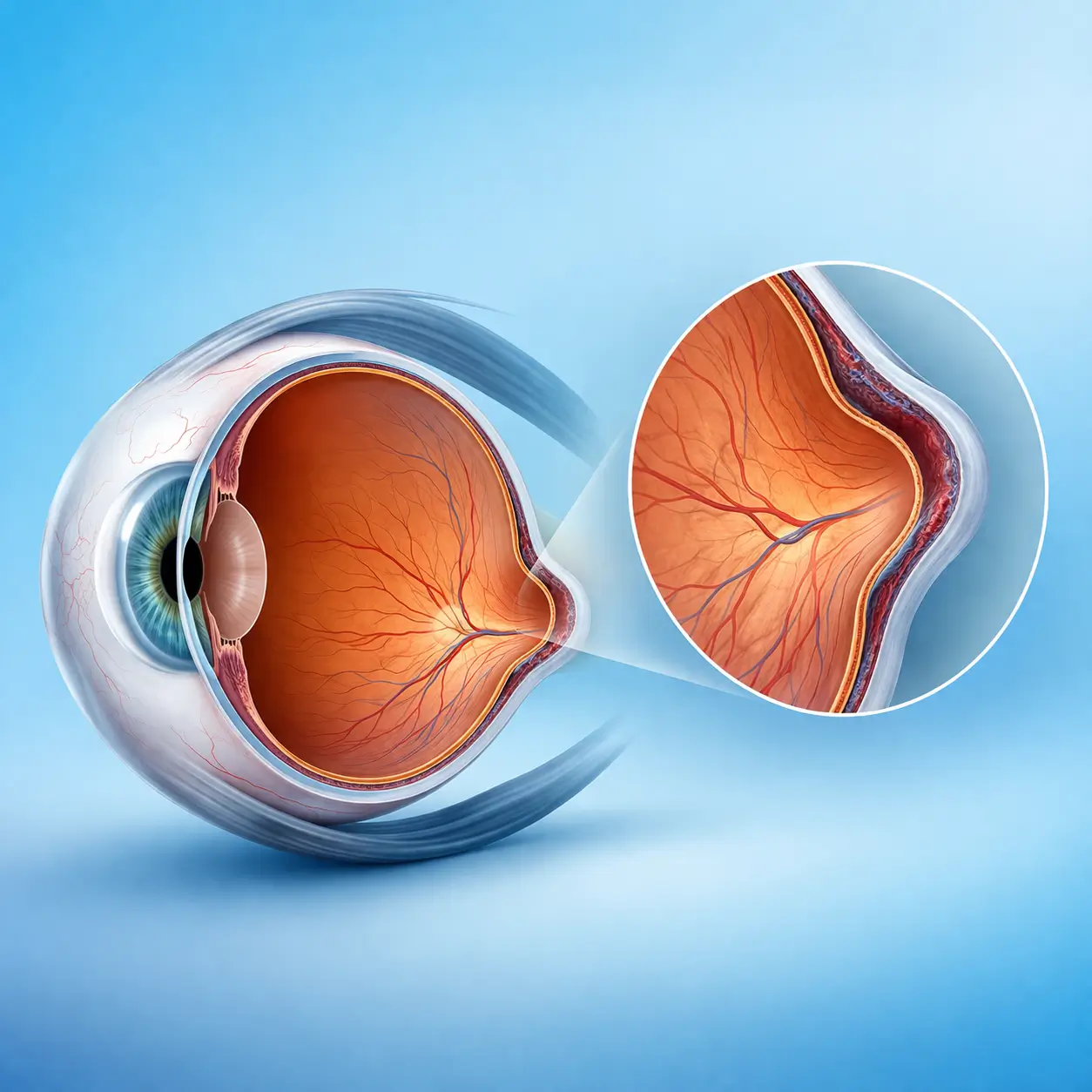
High Myopia Fundus Lesions
A series of degenerative fundus changes caused by excessive axial elongation in high myopia, potentially leading to irreversible vision impairment.
Common Symptoms
Recognizing High Myopia Fundus Lesions
Focus on the most useful decision cues first: common symptoms, the patients or situations that usually prompt review, and any signs that need faster assessment.
Common Symptoms
Signs patients often notice before evaluation
Gradual vision decline (poor corrected vision)
Metamorphopsia (with myopic CNV or macular schisis)
Central scotoma
Increased floaters
Flashes of light
When to Seek Evaluation
Typical patients and situations that warrant review
Patients with myopia >-6.00D (especially >-8.00D)
Those with axial length >26mm
Adolescents with rapidly progressing myopia
High myopia patients experiencing vision loss or metamorphopsia
Adolescent high myopia patients with continuing progression
Fundus abnormalities detected on examination
Urgent Assessment
High myopia patients experiencing sudden vision loss, metamorphopsia, or numerous new floaters should seek prompt evaluation to rule out myopic CNV, retinal detachment, and other acute complications.
Treatment Approaches
Treatment Directions for High Myopia Fundus Lesions
Myopic CNV: anti-VEGF intravitreal injection
Posterior scleral reinforcement: may be considered only in selected progressive high-myopia cases after specialist assessment
Vitrectomy: treat retinoschisis or detachment
Regular fundus monitoring is the cornerstone of management
What usually shapes the treatment plan
Clinical Assessment
Key Assessments for High Myopia Fundus Lesions
These are the main areas doctors usually review first. If you already have relevant test or imaging reports, bring them to speed up the assessment. They are helpful but not required, and the same workup can also be completed in China.
Dilated fundus examination
OCT (macular structural assessment)
OCTA (detect myopic CNV)
Axial length measurement
B-scan ultrasound (posterior staphyloma assessment)
Before You Travel
How to Prepare
Bring previous refraction and axial length measurement records (for progression comparison)
Bring recent OCT and fundus photographs
Planning Notes
Pre-Assessment Required
Comprehensive fundus evaluation, OCT, OCTA, and axial length measurement are needed to assess lesion type and severity.
Remote Pre-Assessment
OCT, fundus photographs, and axial length data can be submitted remotely for preliminary lesion assessment.
Multidisciplinary Assessment
Medical History Important
Myopia history, prescription and axial length trends, and previous fundus treatment history are essential for evaluation and treatment planning.
Ready to Explore Treatment for High Myopia Fundus Lesions?
Let Carevia help you connect with the right specialists, compare hospitals, and plan your medical trip to China.