Transcatheter aortic valve implantation
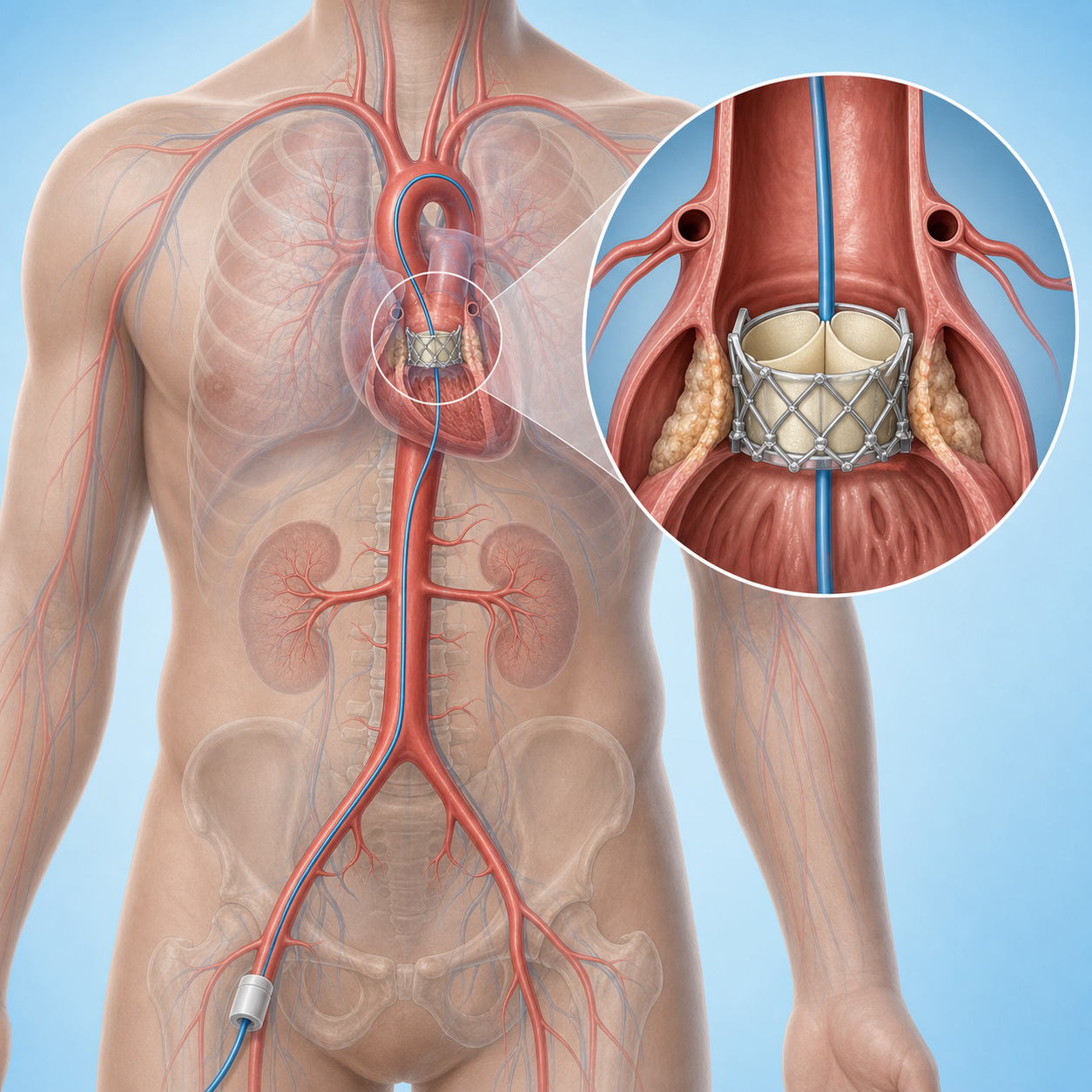
TAVI delivers an artificial valve by catheter into the diseased aortic valve to relieve severe valvular obstruction without conventional open surgical replacement.
Transcatheter aortic valve implantation, or TAVI, deploys an artificial valve within the aortic annulus without removing the native valve and is used for severe aortic stenosis with a confirmed indication for intervention. A valve team must compare it with surgical aortic valve replacement, or SAVR, within a lifetime strategy that integrates age and life expectancy, tricuspid or bicuspid anatomy, femoral access, coronary ostia, pacemaker risk, paravalvular leak, durability, and future coronary or valve-in-valve access. Although TAVI avoids conventional open surgery, it can still cause bleeding, stroke, vascular injury, conduction block, paravalvular leak, kidney injury, infection, further intervention, and death. Age alone or the perception of a smaller procedure must not determine the choice.
Quick Reference
Treatment
1 hours – 2 hours
Observation
0.2 months – 0.9 months
Est. Cost
$28,000 – $29,000
Department
Cardiology
Who Is This For
Is Transcatheter aortic valve implantation Right for You?
Good Candidates
- Severe aortic stenosis with a clear indication for valve intervention, suitable anatomy and vascular access, and a valve-team judgment that the overall TAVI strategy is preferable to SAVR.
- People at high surgical risk and selected people at intermediate or low risk who meet regional criteria based on age, life expectancy, tricuspid anatomy, and suitability for transfemoral access.
- A person whose symptoms, life expectancy, and functional recovery potential permit benefit from relieving obstruction and who accepts long-term echocardiographic and conduction follow-up.
May Not Be Suitable
- Unconfirmed severity or symptom attribution, no indication for intervention, or anatomy and access that do not permit safe valve deployment.
- Some younger people, bicuspid valves or associated aortic disease, a need for simultaneous CABG or other cardiac surgery, or durability considerations may favor SAVR.
- Severe frailty or irreversible pulmonary, malignant, or other disease making valve replacement unlikely to improve survival or quality of life, or preference against invasive treatment.
Step-by-Step Process
How Transcatheter aortic valve implantation Works
Plan with the heart-valve team
Confirm severity and the indication, compare TAVI with SAVR, and select valve size, access, coronary protection, and a pacing contingency.
Deploy the artificial valve by catheter
Usually deliver the valve through the femoral artery, position and deploy it within the aortic annulus, and assess gradient, coronary flow, and paravalvular leak.
Monitor conduction and vascular complications
Observe bleeding, neurologic status, kidney function, and electrocardiographic conduction and define antithrombotic treatment, echocardiography, and long-term valve follow-up.
Follow valve, conduction, and function
Review electrocardiography and echocardiography, the access site, and kidney function, increase activity gradually, and monitor paravalvular leak, valve degeneration, infection, and changing symptoms long term.
Most patients follow a short-stay pathway, but conduction block, vascular complications, or frailty may prolong admission. The artificial valve requires lifelong clinical and echocardiographic follow-up.
Cost Information
Cost Estimate for Transcatheter aortic valve implantation
Estimated Price Range
$28,000 – $29,000
What's Included
CNY 186000–193000 is an estimated full self-pay price without Chinese medical insurance for one uncomplicated complete inpatient pathway of transfemoral, single-valve TAVI. The range uses comparable cash-price components and a pre-reimbursement total from 2 Grade 3A tertiary hospitals in 2 cities, Chongqing and Jinan—The First Affiliated Hospital of Chongqing Medical University and Qilu Hospital of Shandong University—published within the past 4 years; it is a transparent modeled_pathway cross-checked against a published total, not a formal hospital package quote for an international patient. It includes one transcatheter aortic valve and delivery system, the TAVI procedure, anesthesia or sedation, a planned short CCU or ward stay, pre-procedure CTA, echocardiography and laboratory tests, post-procedure ECG monitoring and routine medicines, and review before discharge. It excludes concomitant PCI, a post-procedure permanent pacemaker, treatment of vascular or paravalvular-leak complications, conversion to open surgery, prolonged ICU care or admission, interpreting and international or private-service surcharges, accommodation and international travel. This price applies only to a transfemoral single-valve pathway and must not be generalized to other access routes, valve brands or sizes, or complicated cases; obtain a written full self-pay quote before treatment. Source collection was completed through 2026-07-19.
Before Your Visit
What to Prepare
Required Tests & Examinations
If you already have recent valid test results, bring the reports. If not, these assessments can usually be completed in China before the procedure.
Detailed echocardiography to confirm severity and flow state and CT to assess the annulus, valve, coronary ostia, aorta, and the full vascular access route.
Assess coronary disease, blood count, kidney function, coagulation, infection, dental status, frailty, anesthesia risk, and future coronary and repeat-valve access.
For atypical settings such as low-flow, low-gradient stenosis, use integrated echocardiography, CT, or other testing to confirm truly severe disease and symptom attribution.
Documents & Materials to Bring
Required to Bring
Original echocardiography and CT data, coronary assessment, and records of previous valve or cardiac surgery.
All medicines and allergies, antithrombotic and bleeding history, kidney function, activity, and preferences regarding durability and further intervention.
The valve team's TAVI-versus-SAVR conclusion, planned device size and backup plan, and informed decisions regarding a pacemaker and future intervention.
Companion & Support
A responsible adult should accompany the patient for the procedure or discharge and early recovery; follow local transport, driving, and overnight-supervision rules.
After Treatment
Recovery & Follow-Up
Take antithrombotic medicine as directed and increase activity gradually. A small catheter incision does not remove the risks of stroke, conduction, or valve complications.
Keep the valve brand, model, and implantation report for future MRI, dental care, coronary intervention, or repeat valve treatment.
New syncope, marked bradycardia, breathlessness, neurologic symptoms, or access-site bleeding after discharge may indicate conduction, stroke, or vascular problems and requires immediate care.
Follow-Up Schedule
After discharge, check the access site, electrocardiogram, symptoms, and echocardiography early and then follow the valve pathway. Syncope, neurologic symptoms, chest pain or breathlessness, fever, or access-site bleeding requires emergency care.
Related Conditions
Conditions This Procedure Treats
Ready to Plan Transcatheter aortic valve implantation in China?
Let Carevia help you find the right hospital, coordinate your treatment, and arrange every detail of your medical trip.
Frequently Asked Questions
Need personalized guidance?
Our care coordinators can help you assess whether this procedure fits your situation.
Contact Us