Total hip arthroplasty for a displaced femoral-neck fracture
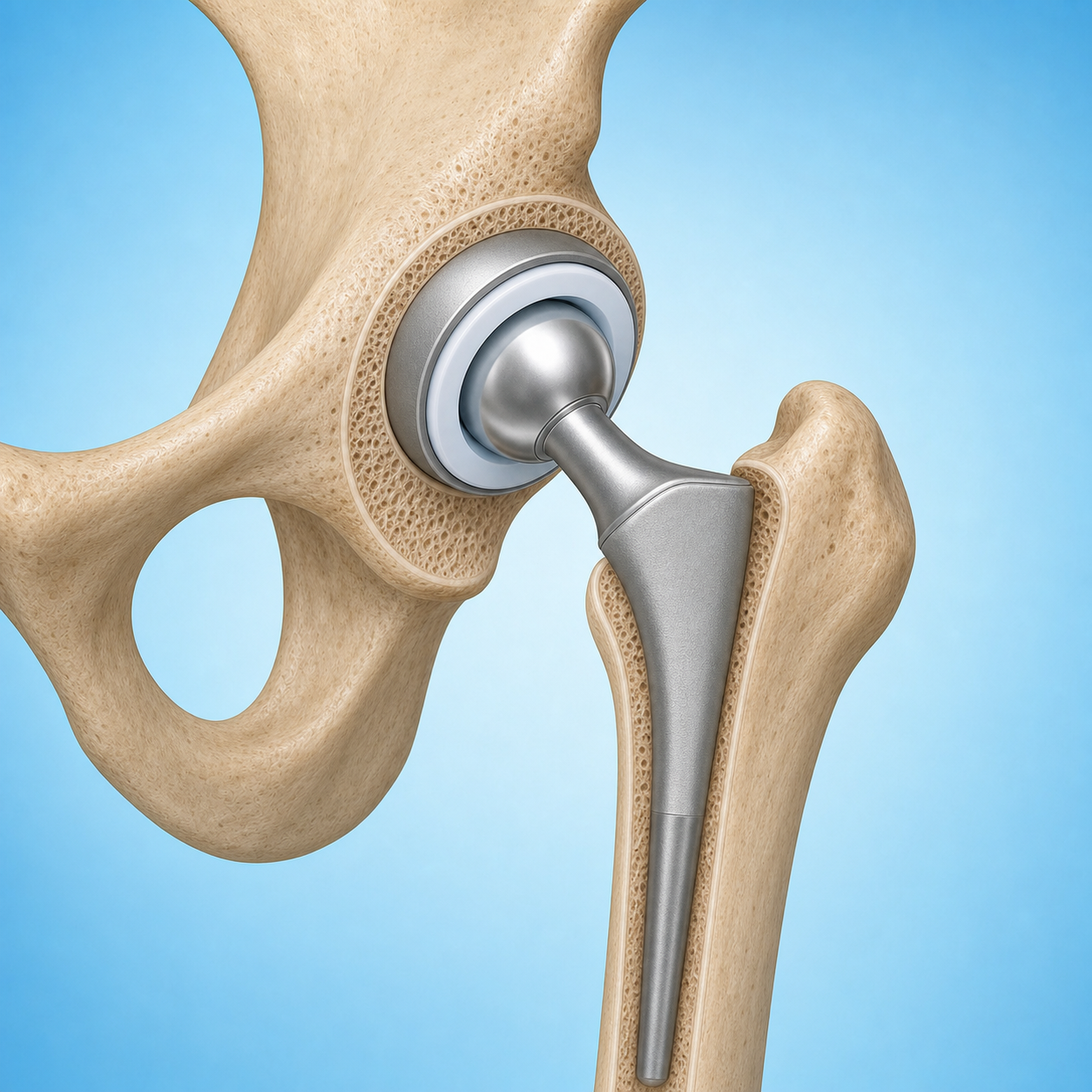
Total hip arthroplasty for a femoral-neck fracture replaces both the femoral head and the acetabular joint surface. It is used for selected displaced intracapsular fractures in patients who were independently mobile before injury, have suitable cognition and general health, and are expected to gain more function from total rather than partial replacement.
Compared with hemiarthroplasty, total hip arthroplasty may provide better long-term hip function but is more complex and may carry greater risks such as dislocation. It replaces both the femoral and acetabular sides, whereas hemiarthroplasty replaces only the femoral side and preserves the native acetabulum. Selection should consider outdoor mobility and independent living before injury, cognition, pre-existing hip disease, operative risk, and the patient's goals. This is acute treatment of a hip fracture, not an elective replacement that can be postponed for cross-border care. The patient should have had good function before injury and be likely to benefit in the long term from replacement of the acetabulum as well, while the team must weigh the longer operation, dislocation risk, physiologic reserve, and ability to provide postoperative care.
Quick Reference
Treatment
45 mins – 1.8 hours
Department
Orthopaedic Surgery
Who Is This For
Is Total hip arthroplasty for a displaced femoral-neck fracture Right for You?
Good Candidates
- A displaced intracapsular femoral-neck fracture in a patient who walked outdoors independently before injury, has no severe cognitive impairment, can tolerate the more complex operation, and is expected to live independently for a substantial period.
- Independent outdoor mobility and daily activities before the fracture, high long-term functional needs, and an ability to participate in rehabilitation and precautions against dislocation.
- Pre-existing symptomatic acetabular degeneration or another factor that creates a high risk of persistent acetabular pain after hemiarthroplasty, when an experienced team confirms greater benefit from total hip arthroplasty.
May Not Be Suitable
- A nondisplaced or extracapsular fracture, or a young patient whose fracture still permits femoral-head-preserving fixation.
- Severe frailty, progressive cognitive impairment, or systemic risk that makes the added complexity of total hip arthroplasty unlikely to yield meaningful functional benefit.
- Any plan that would delay urgent fracture surgery to obtain a specific implant or treatment elsewhere, or a setting without continuous care for geriatric fracture, delirium, and rehabilitation.
Step-by-Step Process
How Total hip arthroplasty for a displaced femoral-neck fracture Works
Compare fracture procedures
Confirm fracture type and side and compare internal fixation, hemiarthroplasty, and total hip arthroplasty in light of pre-fracture function, cognition, the acetabulum, and systemic risk.
Reconstruct the entire hip joint
Remove the fractured femoral head, prepare the native acetabulum, and implant an acetabular cup and liner together with a femoral stem and head to replace both sides and create a stable joint.
Begin acute rehabilitation
Provide analgesia and delirium and thrombosis prevention after surgery, then start weight bearing, mobility, and rehabilitation as soon as it is safe.
Coordinate fracture recovery and further-fracture prevention
In addition to joint rehabilitation, assess delirium, nutrition, falls, and osteoporosis and define the care handoff, clinical reviews, and long-term implant follow-up.
This is urgent inpatient fracture care and must not be delayed for medical travel. A person with a suspected hip fracture should seek the nearest emergency department or local emergency service. Recovery depends on pre-fracture ability, operative complexity, and medical complications.
Cost Information
Cost Estimate for Total hip arthroplasty for a displaced femoral-neck fracture
What's Included
Costs are quoted in Chinese yuan (RMB). For full self-payment without Chinese medical insurance, request a quote for the urgent total-hip pathway for femoral-neck fracture rather than using a single elective-replacement price. Specify the complete acetabular cup, liner, femoral stem, and head system and bearing surface, and confirm inclusion of urgent tests, surgery, anesthesia, the ward, medicines, and routine rehabilitation. Transfusion, intensive care, complications, and a prolonged stay should be priced separately.
Before Your Visit
What to Prepare
Required Tests & Examinations
If you already have recent valid test results, bring the reports. If not, these assessments can usually be completed in China before the procedure.
Urgent imaging and neurovascular examination, assessment of pre-fracture mobility and cognition, and concurrent anticoagulation, cardiopulmonary, infection, and anesthesia review without delaying surgery for unnecessary tests.
Document pre-fracture activity, walking aids, cognition, and living arrangements, and assess other trauma, delirium, skin condition, and neurovascular status of the injured limb.
Assess dislocation risk, acetabular degeneration, anticoagulation, and cardiopulmonary reserve, with joint planning by fracture, arthroplasty, anesthesia, and geriatric teams.
Documents & Materials to Bring
Required to Bring
Images and reports, medication and allergy list, previous surgery and implant records, and any culture or pathology results relevant to the current condition.
Information about pre-fracture function and cognition supported by family, caregivers, or earlier medical records.
Anticoagulant details, earlier hip symptoms and imaging, the patient's goals of care, and plans for rehabilitation and home support after discharge.
Companion & Support
A reliable adult should assist with admission, discharge, transport, medications, and early daily care; complex cases may need support for longer.
After Treatment
Recovery & Follow-Up
Follow the weight-bearing, walking-aid, and dislocation-prevention instructions for the surgical approach and stability, and complete falls and bone-health assessment.
Total hip arthroplasty does not eliminate the risks of death, infection, dislocation, or further surgery; continuous rehabilitation and coordinated care remain important.
Even with a stable incision and implant, a patient with an acute fracture may recover slowly because of delirium, anemia, or systemic complications. Functional goals should be adjusted to the pre-fracture baseline as the condition evolves.
Follow-Up Schedule
Assess general health and early mobility during admission, then review the incision, stability, and rehabilitation after discharge. Sudden pain or deformity, fever, drainage, chest pain or breathlessness, or swelling of the injured limb requires prompt medical care.
Related Conditions
Conditions This Procedure Treats
Ready to Plan Total hip arthroplasty for a displaced femoral-neck fracture in China?
Let Carevia help you find the right hospital, coordinate your treatment, and arrange every detail of your medical trip.
Frequently Asked Questions
Need personalized guidance?
Our care coordinators can help you assess whether this procedure fits your situation.
Contact Us