Removable Partial Denture Restoration
A patient-removable denture uses remaining teeth and mucosa for support to restore chewing function and appearance.
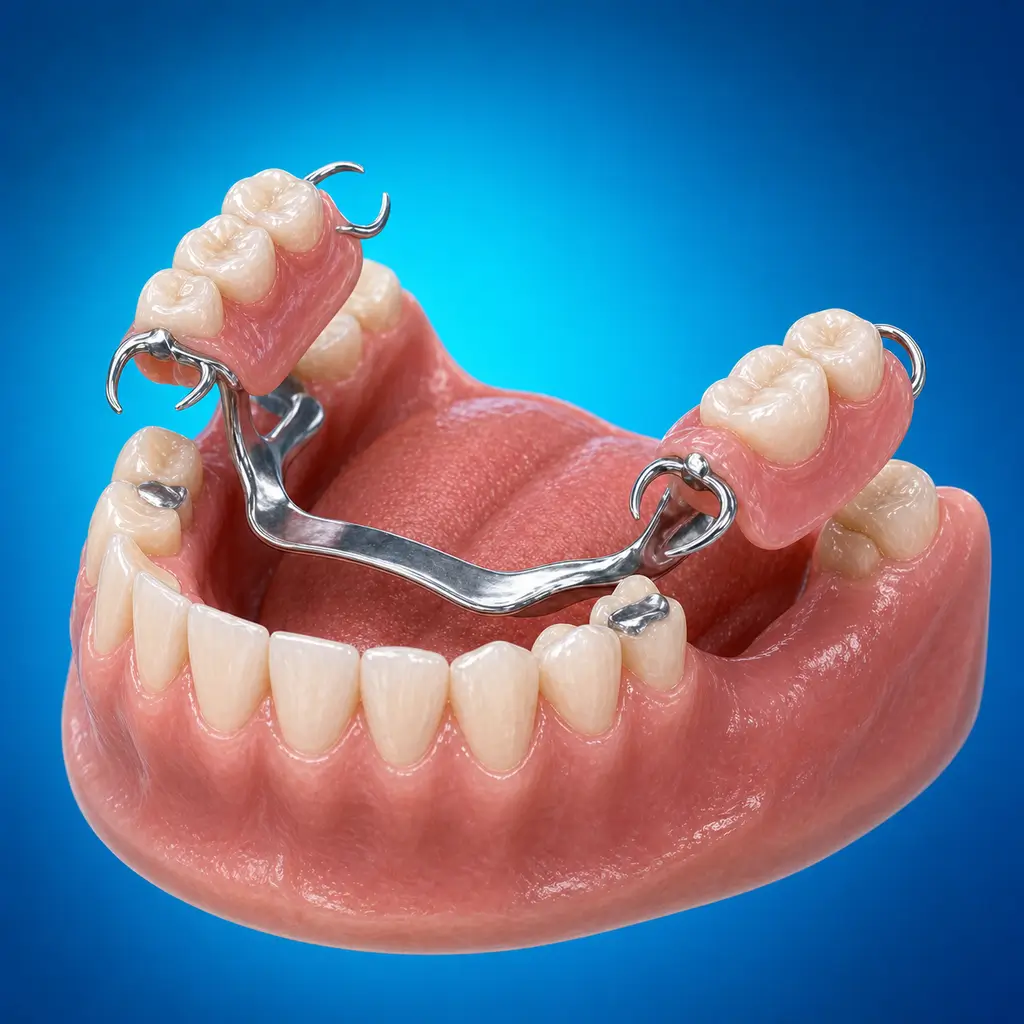
A removable partial denture is a denture the patient can insert and remove to replace some missing teeth in a dental arch. Unlike a fixed bridge, it does not rely on healthy teeth on both sides of the edentulous area as abutments, so it has broader indications, especially when many teeth are missing, abutments on both sides are poor, or the patient does not want healthy teeth prepared. It consists of artificial teeth, a base, clasps or retainers, and connectors. Supported by remaining natural teeth and mucosa, it restores chewing function, improves appearance and speech, and provides some physiologic stimulation to the remaining teeth.
Quick Reference
Treatment
1 hours – 2 hours
Observation
0 mins – 1 days
Est. Cost
$100 – $1,200
Department
Prosthodontics
Who Is This For
Is Removable Partial Denture Restoration Right for You?
Good Candidates
- Partial dentition defects with many missing teeth, such as unilateral or bilateral multiple missing teeth, unsuitable for fixed bridge restoration
- No healthy abutments on both sides of the missing area, such as distal extension defects or loose abutments
- Patients unwilling to prepare healthy teeth for fixed bridge restoration
- Transitional restoration, such as temporary denture before implant restoration
- Multiple remaining teeth need extraction but immediate fixed restoration is not suitable
- Limited finances preventing fixed bridge or implant restoration
- Patients with periodontal disease who need removable dentures for regular periodontal maintenance
May Not Be Suitable
- Complete edentulism, requiring complete dentures
- Allergy to denture base materials
- Very poor oral hygiene and inability to keep the denture clean
- Epilepsy, mental illness, or other conditions preventing cooperation with insertion, removal, and maintenance
- Severe alveolar ridge resorption in the edentulous area, with very poor denture retention that cannot be improved otherwise
- Inability to tolerate the foreign-body sensation of a denture
Step-by-Step Process
How Removable Partial Denture Restoration Works
Initial Evaluation and Design
At the first visit, a comprehensive oral examination evaluates remaining teeth and edentulous areas, X-rays are taken, and study models are made if needed to determine denture type, such as cast framework denture or acrylic base denture, material, and retention method. If non-restorable teeth need extraction, extraction is arranged and 2-3 months are allowed for bone healing.
Impression and Record
At the second visit, selected abutment teeth receive minor preparation, such as adjusting undercuts and preparing rest seats. A precise impression with silicone or alginate material is taken, and occlusion is recorded with a wax bite.
Framework Try-in or Wax Try-in
For cast framework dentures, the metal framework is tried in to check marginal fit, retention, and occlusion.
Laboratory Fabrication
For acrylic base dentures, the wax denture is tried in to check artificial tooth position, arrangement, and occlusion, then adjusted as needed and sent to the laboratory for completion.
Initial Denture Delivery and Adjustment
The fourth visit is initial denture delivery. The finished denture is tried in to check seating, marginal fit, retention, occlusal contacts, and esthetics. Occlusal high spots and overextended borders are adjusted, and the patient is instructed on insertion, removal, cleaning, and wearing precautions.
Follow-up Adjustment
The fifth visit is review and adjustment. One to two weeks after delivery, denture adaptation, pressure pain, or ulcers are assessed, pressure points on the base are relieved, retention and occlusion are checked, and minor adjustments are made as needed.
Usually 4-5 visits are needed, with a total course of about 3-6 weeks.
Cost Information
Cost Estimate for Removable Partial Denture Restoration
Estimated Price Range
$100 – $1,200
What's Included
Plaster models, tooth preparation, materials such as acrylic base, cast framework, pure titanium, or flexible resin, fabrication method, traditional or digital, and price related to tooth number.
Before Your Visit
What to Prepare
Required Tests & Examinations
If you already have recent valid test results, bring the reports. If not, these assessments can usually be completed in China before the procedure.
Clinical oral examination: assess number and position of missing teeth, alveolar ridge shape, health of remaining teeth including mobility, caries and periodontal status, occlusion, and oral mucosa
X-ray examination: assess roots of remaining teeth, alveolar bone height, and periapical lesions
Study models: make upper and lower dental models to analyze occlusion and missing-area morphology
Periodontal assessment: remaining teeth must complete basic periodontal treatment, such as scaling and root planing, and periodontitis must be controlled before denture fabrication
Determine denture design type and material
Documents & Materials to Bring
Required to Bring
Recent oral examination and imaging if available
Previous extraction, periodontal treatment, or denture restoration records
Existing denture or restoration information if available
General medical history
Medication allergy history
Current medication list
Companion & Support
An adult companion is recommended for postoperative pickup and observation. For general anesthesia, sedation, larger procedures, child patients, or patients with limited mobility, arrange accompaniment according to hospital requirements.
After Treatment
Recovery & Follow-Up
Foreign-body sensation, increased saliva, nausea, and other discomfort may occur when first wearing the denture and usually resolve after 1-2 weeks of adaptation.
Practice insertion and removal at first and avoid excessive force that may damage clasps.
Start with soft foods and gradually transition to a normal diet, avoiding very hard or sticky foods.
Remove and rinse the denture after each meal, rinse the mouth, and then reinsert it.
Remove the denture before sleep, clean it, and soak it in cold water. Do not use hot water or alcohol, which can deform it.
Clean the denture daily with a soft toothbrush. Do not use toothpaste, because abrasives can wear the resin.
Remaining teeth should be brushed normally, and abutment proximal surfaces should be cleaned with floss before denture insertion.
Return promptly for adjustment if pressure pain, ulcers, poor retention, or bite discomfort occurs. Do not adjust it yourself.
If the base no longer fits the mucosa after long-term wear, relining or remake is needed.
Follow-Up Schedule
Review and adjust 1-2 weeks after initial wear. Regular follow-up every 3-6 months to check denture fit, retention, and remaining teeth.
Related Conditions
Conditions This Procedure Treats
Ready to Plan Removable Partial Denture Restoration in China?
Let Carevia help you find the right hospital, coordinate your treatment, and arrange every detail of your medical trip.
Frequently Asked Questions
Need personalized guidance?
Our care coordinators can help you assess whether this procedure fits your situation.
Contact Us