Phacoemulsification + Intraocular Lens Implantation
The gold-standard cataract procedure: ultrasonic energy emulsifies and removes the cloudy lens, then an artificial intraocular lens is implanted to restore clear vision.
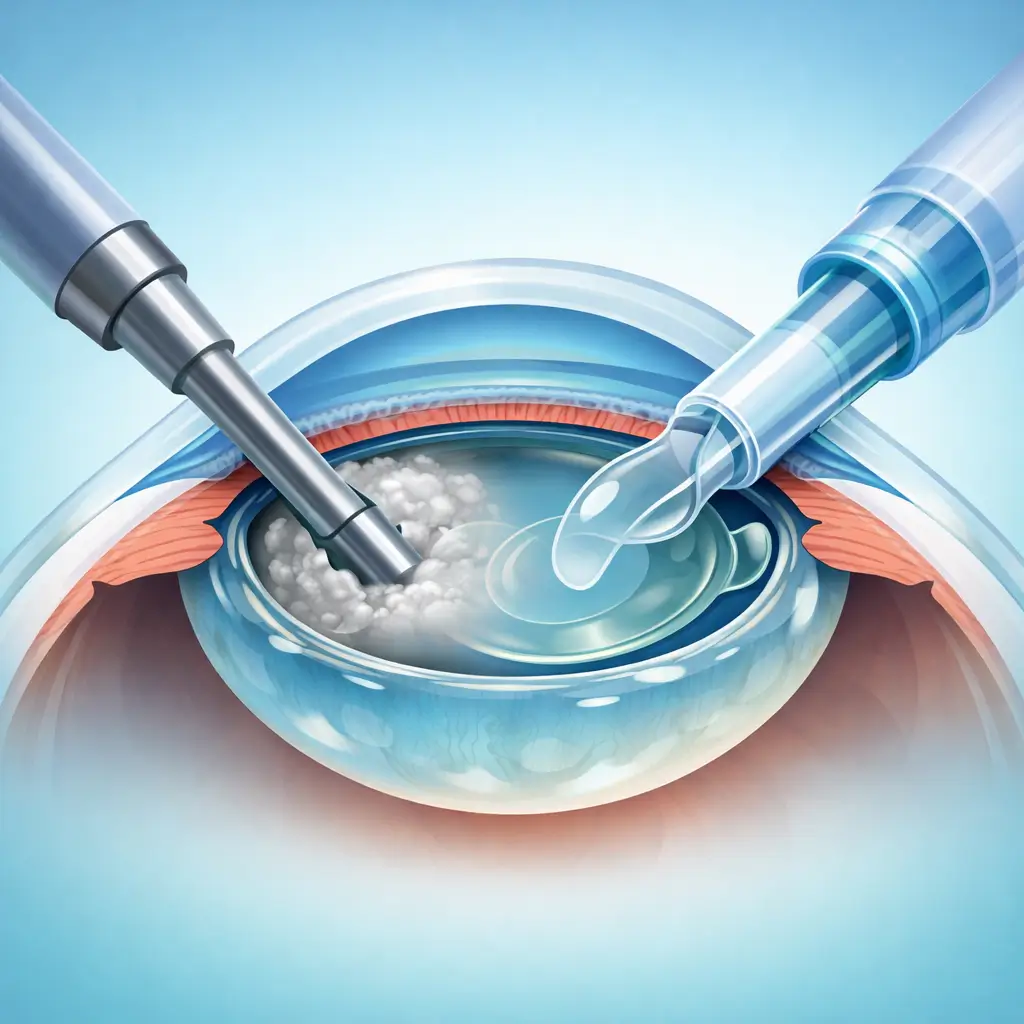
Phacoemulsification with intraocular lens (IOL) implantation is the internationally recognized gold standard for cataract treatment. Performed under local anesthesia, the surgeon creates a micro-incision of approximately 2-3 mm at the corneal limbus, inserts an ultrasonic probe into the anterior chamber, and uses ultrasonic energy to emulsify the opaque crystalline lens into fragments that are then aspirated. A foldable IOL is then implanted through the same incision and unfolds within the capsular bag. The self-sealing incision typically requires no sutures, and the entire procedure is usually completed within 15-45 minutes. IOL selection is the key determinant of postoperative visual quality. Monofocal IOLs (the standard choice covered by public insurance at Tier-3A hospitals) provide sharp vision at a single focal distance, typically set for distance. Multifocal and extended depth-of-focus (EDOF) IOLs address distance, intermediate, and near vision simultaneously, reducing spectacle dependence. Toric IOLs simultaneously correct corneal astigmatism. Premium IOL options are primarily available at high-end private eye hospitals at out-of-pocket cost. Tier-3A public hospitals in China's first-tier cities have high surgical volumes and mature technique. Premium private ophthalmology hospitals offer more personalized IOL consultation, longer appointment times, and an enhanced care experience. Patients with complex comorbidities such as diabetes, high myopia, or coexisting glaucoma are advised to seek treatment at a strong Tier-3A ophthalmology center.
Quick Reference
Treatment
15 mins – 45 mins
Observation
1 days – 3 days
Est. Cost
$1,200 – $7,400
Department
Ophthalmology
Who Is This For
Is Phacoemulsification + Intraocular Lens Implantation Right for You?
Good Candidates
- Lens opacity causing best corrected visual acuity ≤0.5 that impairs daily activities
- Cataract complicated by secondary glaucoma or other complications
- Patients of all ages with cataracts (congenital, traumatic, or diabetic)
- Corneal endothelial cell count ≥1500 cells/mm²
- Systemic health sufficient to tolerate local anesthesia
May Not Be Suitable
- Severely compromised corneal endothelium (<1000 cells/mm²) with risk of corneal decompensation
- Active ocular infection or severe ocular surface inflammation
- Extremely poor general condition precluding cooperation with surgical positioning
- Extreme anxiety preventing cooperation (general anesthesia feasibility must be assessed)
- Very mild cataract with minimal impact on vision (observation recommended)
Step-by-Step Process
How Phacoemulsification + Intraocular Lens Implantation Works
Preparation and Anesthesia
The patient lies supine. Topical anesthetic drops (proparacaine hydrochloride) are instilled; peribulbar or retrobulbar block may be added if needed. The surgical field is sterilized, draped, and the eyelid is held open with a speculum.
Corneal Incisions
A 2-3 mm main clear corneal incision and a 1 mm paracentesis side-port incision are created. The tunnel architecture allows the incision to self-seal under intraocular pressure, typically without sutures.
Capsulorhexis and Hydrodissection
Viscoelastic is injected to maintain anterior chamber depth. A continuous curvilinear capsulorhexis (CCC) of approximately 5-5.5 mm diameter is created. Hydrodissection and hydrodelineation free the nucleus within the capsular bag.
Phacoemulsification and Cortex Removal
The phaco probe is inserted and the nucleus is divided, emulsified, and aspirated using calibrated ultrasonic energy and vacuum. Residual cortex is thoroughly removed with an irrigation/aspiration (I/A) handpiece, preserving the intact posterior capsule.
IOL Implantation
Viscoelastic is injected into the capsular bag. The folded IOL is loaded into an injector and delivered through the main incision, unfolding and centering within the capsular bag. Residual viscoelastic is aspirated and the incision is hydrated to achieve a watertight seal.
Closure and Recovery
Subconjunctival dexamethasone and tobramycin are injected. An eye patch is applied. The patient is monitored in the recovery area for approximately 1-2 hours; once intraocular pressure is confirmed stable, discharge is permitted.
Cataract surgery is a single-session procedure. For bilateral cataracts, the two eyes are typically operated on separately, 1-2 weeks apart. Postoperative antibiotic, corticosteroid, and NSAID eye drops are required for 4-6 weeks.
Cost Information
Cost Estimate for Phacoemulsification + Intraocular Lens Implantation
Estimated Price Range
$1,200 – $7,400
What's Included
Public tier-3A general self-pay: approximately ¥8,000-18,000 per eye (domestic monofocal IOL); tier-3A International Medical Department: approximately ¥15,000-30,000 per eye (imported monofocal or toric IOL); premium private hospitals: approximately ¥25,000-50,000 per eye (imported premium multifocal/trifocal IOL). IOL type is the primary cost driver.
Before Your Visit
What to Prepare
Required Tests & Examinations
If you already have recent valid test results, bring the reports. If not, these assessments can usually be completed in China before the procedure.
Dilated fundus examination (rule out retinal disease, estimate visual prognosis)
Corneal endothelial cell count (assess surgical safety)
Axial length + corneal curvature measurement for IOL power calculation (IOL-Master biometry)
Corneal topography (assess astigmatism, guide Toric IOL selection)
Intraocular pressure measurement (rule out glaucoma)
Systemic preoperative screening (ECG, complete blood count, blood glucose, coagulation panel)
Documents & Materials to Bring
Required to Bring
Recent ophthalmology reports (including corneal endothelial count and fundus exam results)
Medical history documents for systemic conditions (diabetes, hypertension — including recent blood glucose and blood pressure records)
Complete current medication list (especially anticoagulants such as aspirin or warfarin)
Records of any prior eye surgeries (if applicable)
Passport and valid visa
Companion & Support
A responsible adult companion is required on the day of surgery for transportation. Accompanying the patient to the day-1 postoperative visit is also recommended, as the patient may have limited vision due to the eye patch or visual fluctuation.
After Treatment
Recovery & Follow-Up
Do not rub or press the operated eye for at least 1 week; wear the protective shield while sleeping
Avoid swimming and water contact with the eye for 1 month; gently wipe the periocular area with a clean towel
Apply all prescribed eye drops exactly as directed — typically a three-drop regimen (antibiotic + steroid + NSAID); do not stop early
Avoid heavy lifting, bending at the waist, and strenuous exercise for 2 weeks to prevent intraocular pressure spikes
Fluctuating vision in the first 1-3 months is normal; adaptation to multifocal IOLs may take longer
Seek immediate medical attention for sudden severe eye pain, abrupt vision loss, or a large increase in floaters or flashes
Follow-Up Schedule
Follow-up visits are scheduled at postoperative day 1, week 1, month 1, and month 3, then annually. Out-of-town patients may coordinate later follow-up with a local ophthalmologist.
Ready to Plan Phacoemulsification + Intraocular Lens Implantation in China?
Let Carevia help you find the right hospital, coordinate your treatment, and arrange every detail of your medical trip.
Frequently Asked Questions
Need personalized guidance?
Our care coordinators can help you assess whether this procedure fits your situation.
Contact Us