Implantable cardioverter-defibrillator
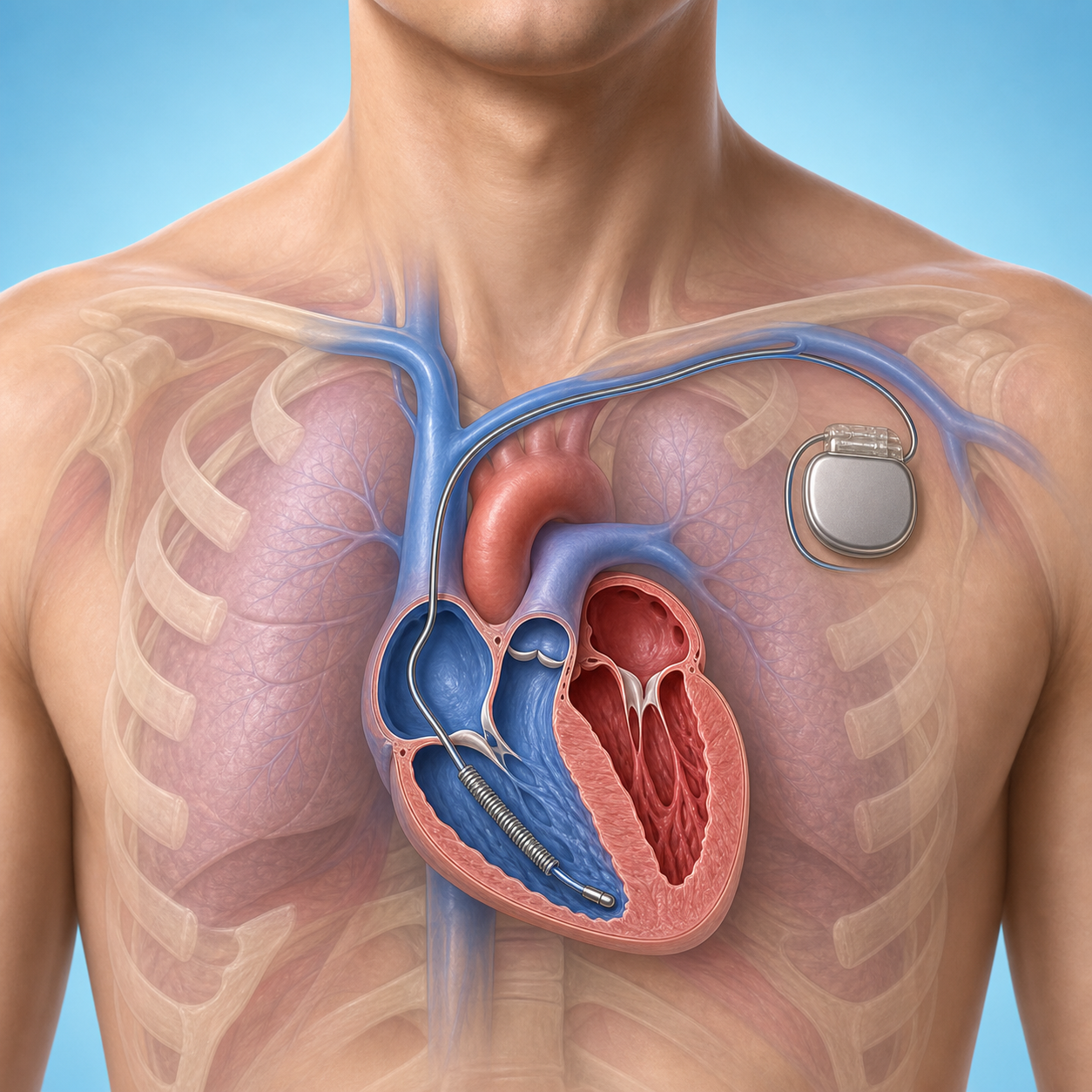
An ICD continuously monitors heart rhythm and delivers antitachycardia pacing or a shock when it detects specified life-threatening ventricular arrhythmias, principally to prevent sudden cardiac death.
An implantable cardioverter-defibrillator, or ICD, continuously monitors for dangerous ventricular arrhythmias and can terminate some lethal episodes with antitachycardia pacing or a shock. It is used for eligible primary or secondary prevention of sudden death. It does not directly improve heart-failure symptoms such as breathlessness or edema and cannot prevent every death. Primary prevention depends on more than left-ventricular ejection fraction; it also requires consideration of cause, duration of optimized medical therapy, waiting periods after myocardial infarction or revascularization, and expected survival with good function. Major risks include infection, bleeding, pneumothorax, lead displacement or failure, inappropriate shock, psychological effects, and further surgery. Future battery replacement and deactivation of shocks at the end of life should be discussed in advance.
Quick Reference
Treatment
1 hours – 1.5 hours
Observation
0.2 months – 0.5 months
Est. Cost
$13,000 – $24,000
Department
Cardiology
Who Is This For
Is Implantable cardioverter-defibrillator Right for You?
Good Candidates
- Secondary prevention after ventricular tachycardia, ventricular fibrillation, or cardiac arrest without a reversible cause.
- Primary prevention when regional criteria for LVEF, symptoms, cause, and adequate medical therapy remain fulfilled and expected survival with good function is more than about 1 year.
- A person willing to attend device checks and remote monitoring and manage future battery or lead problems, and who understands that shocks can affect quality of life.
May Not Be Suitable
- Ventricular arrhythmia entirely caused by a reversible factor, or an incomplete required observation period after myocardial infarction, revascularization, or medical optimization.
- Active infection, no feasible implantation route, or inability to complete required device follow-up. If remote monitoring is unavailable, feasible regular clinic review should be arranged rather than treating remote monitoring as the sole condition.
- Limited expected survival with good function, or informed preference against resuscitative shocks or care goals that do not support them.
Step-by-Step Process
How Implantable cardioverter-defibrillator Works
Confirm prevention indication and goals
Distinguish primary from secondary prevention, exclude reversible causes and premature implantation, and discuss shocks, device deactivation, and end-of-life preferences.
Select and implant the appropriate system
A transvenous lead system is generally selected when pacing or antitachycardia pacing is needed; a subcutaneous ICD can be assessed when pacing is unnecessary and anatomy and risk are suitable. Test sensing and therapy settings after implantation.
Check early complications and provide discharge education
Inspect the incision and assess hematoma, pneumothorax, lead or system position, and device function. Provide the device card and instructions on shocks, driving, activity, and emergency contact.
Program, follow, and decide jointly
Optimize detection and therapy zones to reduce inappropriate shocks, check battery and leads regularly, use remote monitoring to supplement clinic review, and reconsider device therapy as health and care goals change.
Implantation usually requires a short admission. The device needs lifelong monitoring, and battery depletion, lead problems, or infection may require further surgery.
Cost Information
Cost Estimate for Implantable cardioverter-defibrillator
Estimated Price Range
$13,000 – $24,000
What's Included
CNY/RMB 88000–161000 is an estimated full self-pay price without Chinese medical insurance for one uncomplicated, initial transvenous ICD inpatient pathway, represented by a D142 generator plus one compatible same-brand transvenous shock lead. The range uses cash component prices published within the past 4 years in 2 cities, Hefei and Chongqing, by 2 Grade A tertiary hospitals—Hefei First People's Hospital and First Affiliated Hospital of Chongqing Medical University—dated 2025-07-28 and 2026-03-02. It is a transparent modeled_pathway, not a formal hospital package or international-patient quote. It includes the ICD generator, one shock lead, implantation, local anesthesia or sedation, routine sheaths and guidewires, a planned one- to two-night stay, necessary blood tests, ECG, echocardiography or chest radiography, routine medicines and initial programming. It excludes subcutaneous or extravascular ICDs, lead extraction, system upgrade or revision, an additional pacing lead, complications, prolonged admission, and international coordination, interpreting and travel costs. This price represents only an initial transvenous D142-class ICD; single- versus dual-chamber configuration, lead model and hospital inventory can materially change cost. Before treatment, obtain written hospital confirmation of the ICD type and model, lead configuration, full cash price, inpatient scope, and every inclusion and exclusion. Sources were collected through 2026-07-19.
Before Your Visit
What to Prepare
Required Tests & Examinations
If you already have recent valid test results, bring the reports. If not, these assessments can usually be completed in China before the procedure.
Confirm the cause of heart failure, left-ventricular ejection fraction, or LVEF, New York Heart Association functional class, or NYHA class, duration of medical optimization, previous arrhythmias, and timing of infarction and revascularization.
Check electrocardiogram, blood count, kidney function, coagulation, infection, and venous access and assess anesthesia, antithrombotic treatment, and simultaneous eligibility for cardiac resynchronization therapy, or CRT.
Distinguish the need for a transvenous ICD or subcutaneous ICD and assess any need for antitachycardia pacing, bradycardia pacing, or CRT function.
Documents & Materials to Bring
Required to Bring
Continuous electrocardiographic or event recordings, echocardiogram, coronary information, and heart-failure treatment records.
All medicines, anticoagulant or antiplatelet information, infection history, work and driving needs, and available device-follow-up arrangements.
Original arrhythmia electrocardiograms, resuscitation or admission records, serial LVEF and medical-optimization timeline, and preferences regarding shocks and end-of-life management.
Companion & Support
A responsible adult should accompany the patient for the procedure or discharge and early recovery; follow local transport, driving, and overnight-supervision rules.
After Treatment
Recovery & Follow-Up
Initially limit excessive movement of the arm on the implanted side as directed, keep the incision dry, and obtain guidance on driving, work, and electromagnetic-device safety.
A shock may be appropriate or inappropriate; device recordings require professional review and cannot be interpreted by sensation alone.
Contact the team as planned even if you feel well after one shock. Several consecutive shocks, syncope, chest pain, or persistent palpitations require immediate emergency help.
Follow-Up Schedule
Check the incision and leads early, followed by regular in-person or remote programming. Contact the team after a shock as instructed. Repeated shocks, persistent symptoms, syncope, chest pain, or signs of infection require emergency care.
Related Conditions
Conditions This Procedure Treats
Ready to Plan Implantable cardioverter-defibrillator in China?
Let Carevia help you find the right hospital, coordinate your treatment, and arrange every detail of your medical trip.
Frequently Asked Questions
Need personalized guidance?
Our care coordinators can help you assess whether this procedure fits your situation.
Contact Us