Endovascular abdominal aortic aneurysm repair
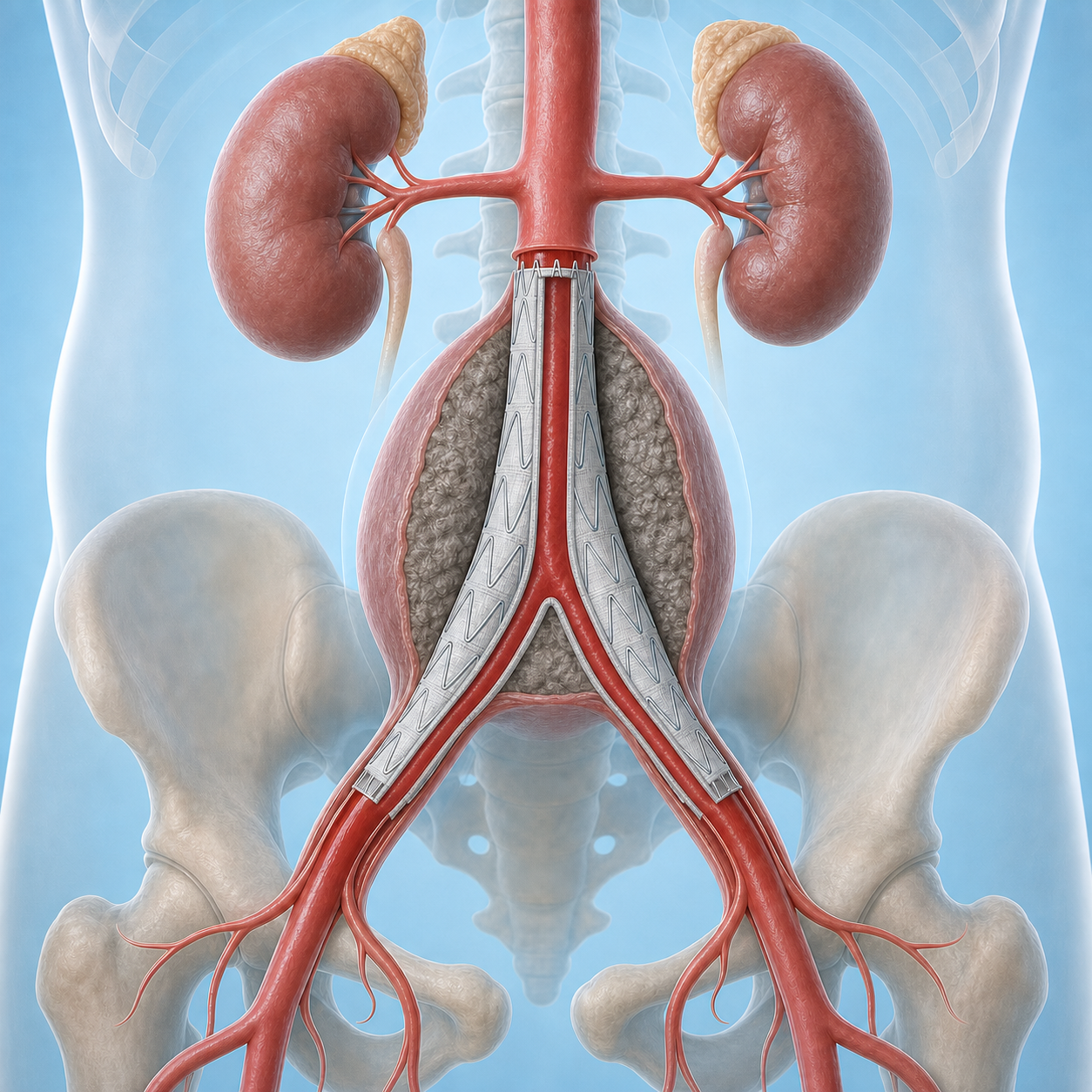
EVAR places a stent graft through the groin arteries into the abdominal aorta and iliac arteries so that blood bypasses the aneurysm sac, for an abdominal aortic aneurysm that meets repair criteria and has suitable anatomy.
The repair decision must integrate symptoms, diameter, growth, sex, anatomy, life expectancy, and operative risk. European Society for Vascular Surgery, or ESVS, 2024 guidance does not recommend routine elective repair of an asymptomatic abdominal aortic aneurysm smaller than 55 mm in men or 50 mm in women. Endovascular aneurysm repair, or EVAR, has a lower early treatment burden but requires long-term imaging for endoleak, sac enlargement, graft migration or occlusion, and device failure. Major risks include bleeding, vascular injury, kidney injury, limb ischemia, endoleak, reintervention, infection, rupture, and death. EVAR uses a stent graft to exclude the aneurysm sac from blood flow; success depends not only on the absence of an obvious initial endoleak but also on proximal and distal sealing, iliac-limb patency, and long-term sac behavior. The device must match its instructions for use and the person's anatomy. If a complex off-label plan is used, an experienced center should fully explain durability, reintervention, and the possibility of emergency conversion to open surgery.
Quick Reference
Treatment
1 hours – 3 hours
Observation
3 days – 0.2 months
Department
General Surgery
Who Is This For
Is Endovascular abdominal aortic aneurysm repair Right for You?
Good Candidates
- Aneurysm-related symptoms, rapid growth, or meeting local repair criteria, with proximal neck, iliac, and access anatomy suitable for an approved device.
- Life expectancy and physical condition sufficient to benefit from repair, with ability to complete long-term imaging and necessary reintervention.
- A person who understands that a less invasive procedure is not permanent completion of treatment and can return long term to a center capable of vascular imaging and reintervention.
May Not Be Suitable
- No indication for repair, anatomy outside safe device limits, or inability to obtain vascular access.
- Contrast, kidney-function, infection, life-expectancy, or follow-up limitations that make risk exceed benefit; suspected rupture requires the local emergency pathway rather than an elective pathway.
- An infected aneurysm, connective-tissue disorder, or another special cause for which the appropriateness and durability of standard EVAR require separate specialist judgment.
Step-by-Step Process
How Endovascular abdominal aortic aneurysm repair Works
Confirm the indication and device anatomy
Compare EVAR with open repair and select a stent-graft size, sealing zones, and access route within the device instructions for use.
Implant the stent graft
Deliver and deploy the main body and limbs through femoral access so blood flows through the graft, then use angiography to check for endoleak, branch perfusion, and lower-limb flow.
Monitor the device and aneurysm sac for life
After surgery, use ultrasound, CT, or another protocol to assess endoleak, sac change, migration, occlusion, and device integrity.
Manage endoleak and sac change
Use follow-up imaging to classify the endoleak and its clinical importance; obtain timely further assessment and reintervention for sac enlargement, graft migration, or occlusion.
EVAR is usually completed during a short hospital stay, but complex anatomy and complications prolong care. Postoperative imaging is not optional, and an endoleak or enlarging sac may require another intervention.
Cost Information
Cost Estimate for Endovascular abdominal aortic aneurysm repair
What's Included
Costs are quoted in Chinese yuan (RMB). For full self-payment without Chinese medical insurance, the quotation should be based on stent-graft brand, number of main-body and limb components, anatomical complexity, and access route. It should itemize preoperative CTA, devices and catheters, the procedure, contrast, anesthesia, intensive-care or hospital stay, and postoperative imaging surveillance. Endoleak treatment and reintervention are charged separately.
Before Your Visit
What to Prepare
Required Tests & Examinations
If you already have recent valid test results, bring the reports. If not, these assessments can usually be completed in China before the procedure.
Thin-slice contrast-enhanced CT angiography for stent-graft sizing and preoperative planning, including the proximal neck, iliac arteries, important branches, and vascular access.
Check complete blood count, kidney function, coagulation, cardiopulmonary status, medications, and allergies, and assess open repair as an alternative and the ability to complete long-term follow-up.
Confirm relationships to the renal and visceral branches, neck length and angulation, iliac diameter and calcification, and femoral access, and plan whether branch preservation is needed.
Documents & Materials to Bring
Required to Bring
Original CT angiography data and three-dimensional measurements, plus previous diameter and growth records.
All medications and allergies, kidney function, previous abdominal or vascular surgery, and the long-term imaging arrangement.
The final implanted stent-graft brand, model, components, lot numbers, and postoperative baseline images so future device problems can be identified.
Companion & Support
A responsible adult should accompany the person for surgery or discharge and during early recovery; follow local transport, driving, and overnight-supervision rules.
After Treatment
Recovery & Follow-Up
Care for the groin incisions, increase activity gradually, and protect kidney function as instructed; continue smoking cessation and cardiovascular risk management.
EVAR is not a procedure that removes the need for future checks; endoleak or a device problem can occur without symptoms.
New persistent abdominal or back pain, fainting, sudden lower-limb ischemia, or fever suggesting infection requires emergency assessment even years later, and the person should report the previous EVAR.
Follow-Up Schedule
Complete early and long-term imaging according to the device and center protocol. New abdominal or back pain, fainting, a cold lower limb, fever, or access-site bleeding requires urgent assessment.
Related Conditions
Conditions This Procedure Treats
Ready to Plan Endovascular abdominal aortic aneurysm repair in China?
Let Carevia help you find the right hospital, coordinate your treatment, and arrange every detail of your medical trip.
Frequently Asked Questions
Need personalized guidance?
Our care coordinators can help you assess whether this procedure fits your situation.
Contact Us