Dental Implant Surgery
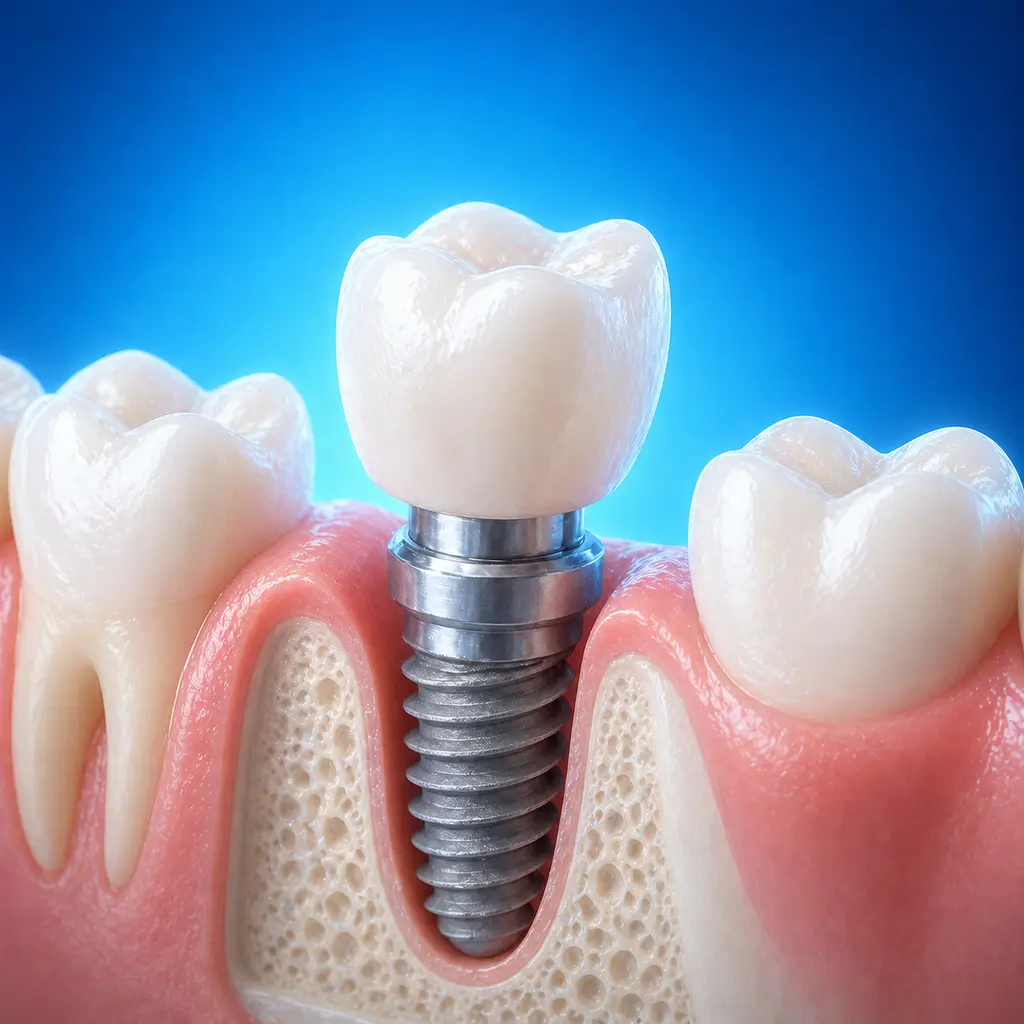
An artificial root, or implant, is placed into the alveolar bone of the missing tooth area, and after osseointegration a crown is installed above it to restore chewing function and appearance.
Dental implant surgery places an artificial root, made of pure titanium or titanium alloy, into the alveolar bone of the missing tooth area. After a 3-6 month osseointegration period, during which the implant forms a firm connection with bone, an abutment and crown are installed on top to restore the missing tooth's shape and function. Compared with traditional fixed bridges, implants do not require preparation of healthy adjacent teeth and can effectively prevent alveolar bone resorption in the missing area. They are currently considered the tooth replacement method closest to natural teeth. Depending on bone conditions, simultaneous or staged bone augmentation may be needed, such as guided bone regeneration, sinus lift, or block bone grafting. With standardized maintenance, implants can be used long-term but cannot be guaranteed for life. Service life is affected by oral hygiene, periodontal status, smoking, blood glucose control, occlusal load, and regular maintenance.
Quick Reference
Treatment
1 hours – 3 hours
Observation
0 mins – 1 days
Est. Cost
$400 – $7,300
Department
Implant Dentistry
Who Is This For
Is Dental Implant Surgery Right for You?
Good Candidates
- Good general health with no contraindications to implant surgery
- Single or multiple missing teeth with healthy adjacent teeth and unwillingness to prepare healthy tooth structure
- Complete edentulism with poor retention of conventional complete dentures or inability to adapt to them
- Adequate alveolar bone height and width in the missing area, or ability to meet implant conditions after bone augmentation
- No severe periodontal disease, uncontrolled diabetes, osteoporosis, coagulation disorder, or similar problems
- No severe smoking habit, or willingness to quit or reduce smoking
- Good oral hygiene habits and compliance with regular follow-up
May Not Be Suitable
- Uncontrolled severe systemic disease
- Severe osteoporosis with long-term bisphosphonate use
- Uncontrolled severe periodontal disease or very poor oral hygiene
- Severe bone deficiency in the missing area that cannot be improved by bone augmentation
- Pregnancy or breastfeeding
- Heavy smoking, more than 20 cigarettes per day, with inability to quit
- History of head and neck radiotherapy, with risk of osteoradionecrosis
- Mental illness or unrealistic psychological expectations
Step-by-Step Process
How Dental Implant Surgery Works
Preoperative Preparation
Rinse with chlorhexidine before surgery.
First-stage Surgery, Implant Placement
After local infiltration or block anesthesia, an incision is made along the alveolar crest and a mucoperiosteal flap is raised to expose bone. According to the implant system protocol, sequential drills prepare the implant osteotomy while precisely controlling three-dimensional position, axis, and depth. The implant is screwed into the prepared site to the planned depth, and a cover screw or healing abutment is installed. For non-submerged implants, where the healing abutment is exposed in the mouth, the flap is sutured directly.
Wound Closure and Postoperative Imaging
For submerged implants, the wound is sutured closed and the implant is completely buried under the mucosa. Immediate postoperative X-ray checks implant position, and cold compresses reduce swelling.
Osseointegration Period
Wait for firm integration between implant and bone. The maxilla requires 4-6 months and the mandible 3-4 months, during which implant loading should be avoided.
Second-stage Surgery, Submerged Implants Only
After osseointegration, the mucosa is opened under local anesthesia to expose the implant, and a healing abutment is installed to shape the gingival cuff. After about 2-4 weeks of gingival healing, the restorative phase can begin.
Superstructure Restoration, Impression and Crown Delivery
Impressions are taken with implant-level open-tray or closed-tray techniques, and occlusion is recorded. The laboratory fabricates the implant superstructure, such as a single crown, splinted crowns, or overdenture, in about 1-2 weeks. At delivery, the restoration is tried in, marginal fit, proximal contact, and occlusion are checked, then it is cemented or screw-retained, occlusal high spots are adjusted, and restoration is completed.
Review and Maintenance
After crown delivery, follow-up is scheduled at 1 week, 1 month, 3 months, 6 months, and 1 year to assess implant stability, osseointegration, and restoration status, then every 6-12 months.
Conventional implant treatment usually includes implant placement, waiting for osseointegration, impression taking, and superstructure restoration. Osseointegration generally takes 3-6 months. If bone grafting, sinus lift, or staged surgery is needed, the course may extend beyond 6 months. Immediate implantation or immediate restoration may be considered for suitable patients, but indications must be strictly assessed.
Cost Information
Cost Estimate for Dental Implant Surgery
Estimated Price Range
$400 – $7,300
What's Included
Cost varies by implant brand, domestic, Korean, German, or Swiss, restorative material, porcelain-fused-to-metal or all-ceramic, whether bone augmentation is needed, and surgical complexity.
Before Your Visit
What to Prepare
Required Tests & Examinations
If you already have recent valid test results, bring the reports. If not, these assessments can usually be completed in China before the procedure.
Clinical oral examination: assess alveolar ridge shape, thickness, and height in the missing area, adjacent and opposing teeth, occlusion, oral hygiene, and periodontal status
CBCT: mandatory before implant surgery, providing three-dimensional assessment of bone height, width, density, and relationship to important structures; it is the core basis for implant planning
General health assessment
Documents & Materials to Bring
Required to Bring
Recent dental imaging, such as CBCT, panoramic radiograph, or periapical radiograph
Previous extraction, periodontal treatment, implant, or restoration records
General medical history, especially diabetes, osteoporosis, or antiresorptive drug use
Current medication list, especially anticoagulants, bisphosphonates, or other antiresorptive drugs
Medication allergy history
Recent blood glucose, coagulation function, bone metabolism, or other preoperative test results if completed
Companion & Support
A dedicated companion is usually not needed. For children, older adults, pregnancy, underlying medical conditions, or when treatment may affect eating or travel afterward, having a family member accompany the patient is recommended.
After Treatment
Recovery & Follow-Up
Apply cold compresses within 24 hours after surgery for 20-30 minutes each time with 1-hour intervals to reduce swelling.
Two hours after surgery, warm or cool liquid food may be eaten. Eat soft food for 1 week and avoid very hot, hard, or spicy foods.
Do not brush or rinse within 24 hours after surgery. From the next day, gently rinse with chlorhexidine mouthwash twice daily for 1-2 weeks.
Avoid strenuous exercise, forceful sucking, and spitting for 1 week after surgery.
If antibiotics are prescribed, use them as instructed; take pain medication if needed.
Suture removal in 1-2 weeks; absorbable sutures do not need removal.
During osseointegration, 3-6 months, avoid chewing hard objects in the implant area and do not load the implant.
Maintain good oral hygiene and use a soft-bristled toothbrush to clean around the implant, especially if the healing abutment is exposed.
Stop smoking for at least 3 months, because smoking significantly increases implant failure risk.
Return promptly if persistent bleeding, severe pain, fever, or implant loosening occurs.
Follow-Up Schedule
Suture removal follow-up 7-10 days after surgery. Osseointegration review 3-6 months after surgery. After crown delivery, follow-up at 1 week, 1 month, 3 months, 6 months, and 1 year, then every 6-12 months.
Related Conditions
Conditions This Procedure Treats
Ready to Plan Dental Implant Surgery in China?
Let Carevia help you find the right hospital, coordinate your treatment, and arrange every detail of your medical trip.
Frequently Asked Questions
Need personalized guidance?
Our care coordinators can help you assess whether this procedure fits your situation.
Contact Us