Cardiac resynchronization therapy
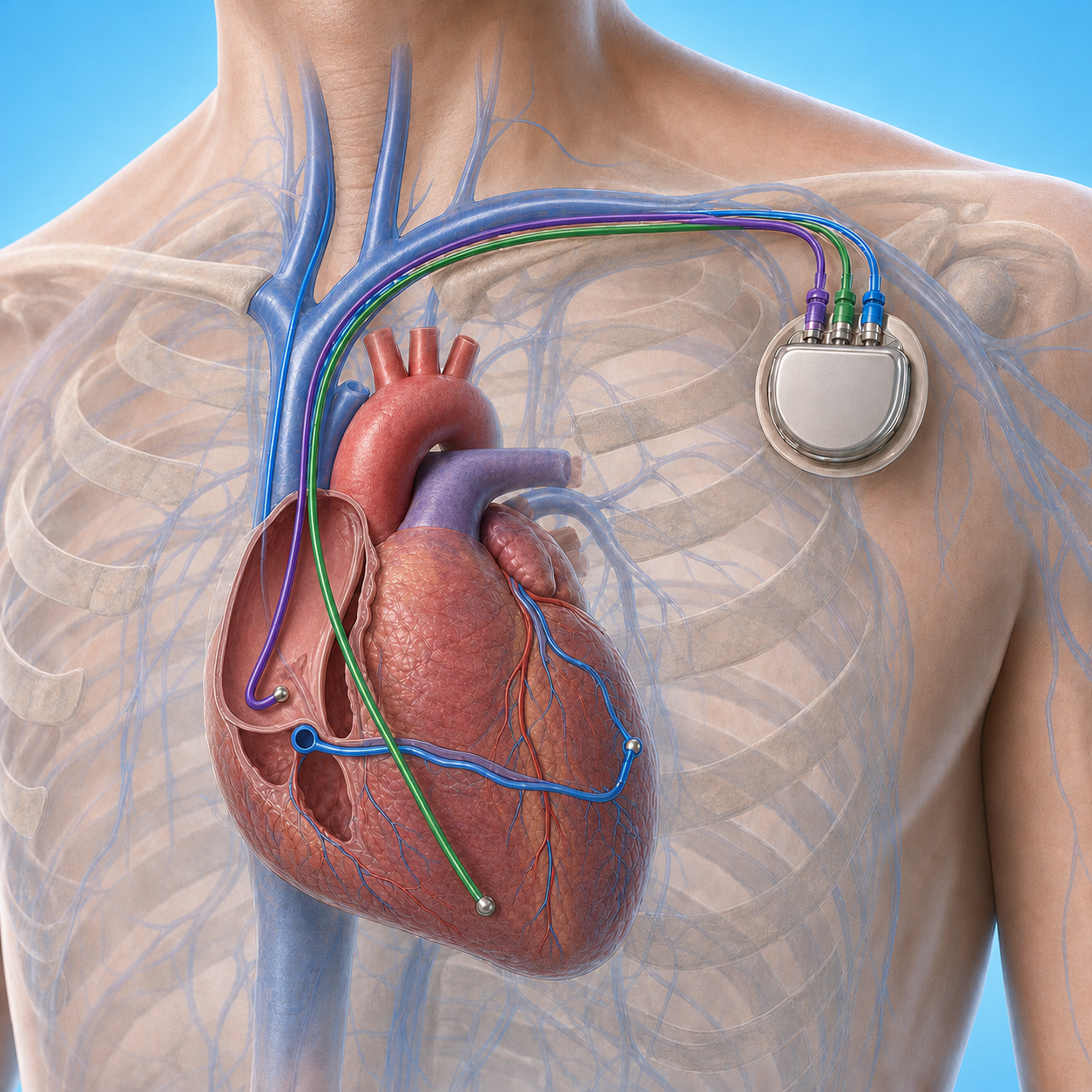
CRT coordinates right- and left-ventricular activation to improve pumping efficiency in selected patients with HFrEF and electromechanical dyssynchrony. It can use pacing-only CRT-P or defibrillation-capable CRT-D.
The clearest benefit is generally in patients who remain symptomatic despite optimized medical therapy, have an LVEF no higher than 35%, sinus rhythm, left bundle-branch block, or LBBB, and a QRS duration no shorter than 150 milliseconds. A QRS of 130 to 149 milliseconds, non-LBBB morphology, atrial fibrillation, or an expected high proportion of ventricular pacing requires further stratification. CRT should not be used routinely for a narrow QRS without another pacing indication. Regional guidance differs on the lower QRS boundary, so the applied standard must be stated. Cardiac resynchronization therapy, or CRT, coordinates ventricular activation to improve pump efficiency in selected heart-failure patients with electrical dyssynchrony, but not every person with a wide QRS responds. Benefit is closely related to LBBB morphology, QRS duration, LVEF, rhythm, and the proportion of effective biventricular pacing. Medical optimization, programming, and echocardiographic review remain necessary, and some patients have no substantial reverse remodeling.
Quick Reference
Treatment
2 hours – 3 hours
Observation
0.2 months – 0.7 months
Est. Cost
$16,000 – $39,000
Department
Cardiology
Who Is This For
Is Cardiac resynchronization therapy Right for You?
Good Candidates
- Persistent symptoms after optimized medicines with LVEF, QRS duration, and morphology meeting regional guidance, particularly LBBB with QRS no shorter than 150 ms.
- A person expected to need a high proportion of ventricular pacing, with atrial fibrillation, or in another special group when electrophysiology and heart-failure teams judge that resynchronization is likely to help.
- A person able to complete implantation and remote or clinic device follow-up while continuing heart-failure medicines and managing atrial fibrillation and other factors that reduce effective pacing.
May Not Be Suitable
- A narrow QRS without another pacing indication, or symptoms and impaired cardiac function not driven by correctable electrical dyssynchrony.
- Active infection, venous or coronary-sinus anatomy that prevents implantation, or inability to obtain adequate effective resynchronization without a corrective option.
- Irreversible comorbidity and limited functional survival making heart-failure improvement unlikely, or inability to accept long-term device follow-up.
Step-by-Step Process
How Cardiac resynchronization therapy Works
Confirm the indication for electrical dyssynchrony
Verify LVEF, QRS morphology and duration, rhythm, symptoms, and medical optimization and select CRT-P or CRT-D.
Implant the resynchronization pacing system
A standard biventricular system places a right-ventricular lead and, as rhythm requires, a right-atrial lead, then a left-ventricular lead through the coronary sinus. If a conventional left-ventricular lead is not feasible, an experienced team can assess another resynchronization or conduction-system pacing approach.
Optimize synchronization and follow-up
Program pacing timing, check the proportion of effective biventricular pacing, and assess response by electrocardiogram, symptoms, and echocardiography.
Assess clinical and reverse-remodeling response
With adequate effective pacing, reassess symptoms, admissions, electrocardiography, and echocardiography. If there is no response, examine lead position, atrial fibrillation, ventricular ectopy, and programming.
Implantation usually requires a short admission. Not every patient has marked reverse remodeling; response is assessed over several months, and the device requires lifelong management.
Cost Information
Cost Estimate for Cardiac resynchronization therapy
Estimated Price Range
$16,000 – $39,000
What's Included
Critical identity limit: CNY/RMB 109000–262000 represents CRT-D only and does not represent the usually lower-priced CRT-P; this restriction must not be weakened until the treatment entity is split. It is an estimated full self-pay price without Chinese medical insurance for one uncomplicated, initial transvenous CRT-D complete inpatient pathway, specifically one CRT-D generator plus three leads: right-ventricular shock, left-ventricular and atrial. The range uses cash component prices published within the past 4 years in 2 cities, Hefei and Chongqing, by 2 Grade A tertiary hospitals—Hefei First People's Hospital and First Affiliated Hospital of Chongqing Medical University—dated 2025-07-28 and 2026-03-02. It is a transparent modeled_pathway, not a formal hospital package or international-patient quote. It includes the CRT-D generator, the three stated leads, a delivery sheath or its modeled uplift coverage, implantation, local anesthesia or sedation, a planned one- to two-night stay, necessary tests and medicines, and initial programming optimization. It excludes CRT-P, lead extraction, system upgrade or revision, extra devices for complex coronary venous anatomy, complications, prolonged admission, and international coordination and travel costs. Before treatment, obtain written hospital confirmation that the device is CRT-D and not CRT-P, plus generator and lead models, the full cash self-pay price, inpatient scope, and every inclusion and exclusion. Sources were collected through 2026-07-19.
Before Your Visit
What to Prepare
Required Tests & Examinations
If you already have recent valid test results, bring the reports. If not, these assessments can usually be completed in China before the procedure.
Review the QRS duration and morphology on a 12-lead electrocardiogram, rhythm, LVEF, New York Heart Association functional class, or NYHA class, and medical optimization.
Assess venous and coronary-sinus access, kidney function, coagulation, infection, atrial-fibrillation burden, and the choice between pacing-only CRT, or CRT-P, and defibrillation-capable CRT, or CRT-D.
Clarify the need for defibrillation, anticipated venous or coronary-sinus difficulty, and the plan for ventricular-rate control or atrioventricular-node treatment in atrial fibrillation.
Documents & Materials to Bring
Required to Bring
Original electrocardiograms, echocardiograms, rhythm monitoring, and information on any previous pacemaker.
All medicines, antithrombotic information, infection history, heart-failure symptoms, and available remote device follow-up.
Serial LVEF, NYHA function, QRS electrocardiograms, and medicine-dose records, plus models, leads, and programming information from previous devices.
Companion & Support
A responsible adult should accompany the patient for the procedure or discharge and early recovery; follow local transport, driving, and overnight-supervision rules.
After Treatment
Recovery & Follow-Up
Initially restrict movement of the arm on the implanted side as directed and follow driving, work, and electromagnetic-environment guidance.
Atrial fibrillation, ventricular ectopy, or lead position can reduce effective pacing and may require medicines, programming, or another procedure.
CRT improvement usually takes weeks to months and cannot be judged from the first few days after implantation. Worsening heart-failure symptoms still require the decompensation plan.
Follow-Up Schedule
Check the incision and leads early, then program effective pacing and review symptoms and LVEF. Fever or drainage, persistent diaphragmatic stimulation, syncope, worsening heart failure, or a device alert needs prompt care.
Related Conditions
Conditions This Procedure Treats
Ready to Plan Cardiac resynchronization therapy in China?
Let Carevia help you find the right hospital, coordinate your treatment, and arrange every detail of your medical trip.
Frequently Asked Questions
Need personalized guidance?
Our care coordinators can help you assess whether this procedure fits your situation.
Contact Us