Abdominal aortic aneurysm ultrasound surveillance and risk management
For an asymptomatic abdominal aortic aneurysm that has not met repair criteria, diameter and growth are measured regularly with a consistent method while smoking cessation and blood pressure, lipid, and overall cardiovascular risk are managed.
Abdominal aortic aneurysm, or AAA, surveillance cannot reduce rupture risk to zero, and no medicine has been reliably proven to stop AAA growth. European Society for Vascular Surgery, or ESVS, 2024 guidance suggests for men: 3.0 to 3.9 cm about every 3 years, 4.0 to 4.9 cm yearly, and 5.0 cm or more every 6 months; for women: 3.0 to 3.9 cm about every 3 years, 4.0 to 4.4 cm yearly, and 4.5 cm or more every 6 months. Exact intervals, measurement method, and repair thresholds must be adapted to the local program and individual risk. Surveillance quality depends on repeatable measurement and closed-loop management, not merely having an ultrasound from time to time. The report should record maximum diameter, measurement plane, and change from the previous study, and state who reviews the result and schedules the next examination. When the aneurysm is near the repair threshold, growth appears abnormal, or measurements differ substantially, a shorter interval or confirmation with CT may be needed.
Quick Reference
Observation
0 mins
Department
General Surgery
Who Is This For
Is Abdominal aortic aneurysm ultrasound surveillance and risk management Right for You?
Good Candidates
- An asymptomatic aneurysm whose diameter and growth have not met local repair criteria, when the person can complete scheduled imaging and result review.
- A person who needs to optimize smoking cessation and systemic atherosclerotic risk during observation and maintain fitness for possible future repair.
- A person who understands that observation is not abandonment of treatment, can attend scheduled imaging, and will seek emergency care immediately for new abdominal or back pain, fainting, or shock symptoms.
May Not Be Suitable
- Suspected rupture, new aneurysm-related abdominal or back pain, fainting, or circulatory instability; routine outpatient ultrasound must not continue in these circumstances.
- Rapid growth or meeting local criteria for repair assessment, which requires referral to a vascular team instead of retaining the previous surveillance interval.
- No defined measurement method, repeat-imaging date, or person responsible for results, or mutually incomparable imaging when the person cannot return promptly.
Step-by-Step Process
How Abdominal aortic aneurysm ultrasound surveillance and risk management Works
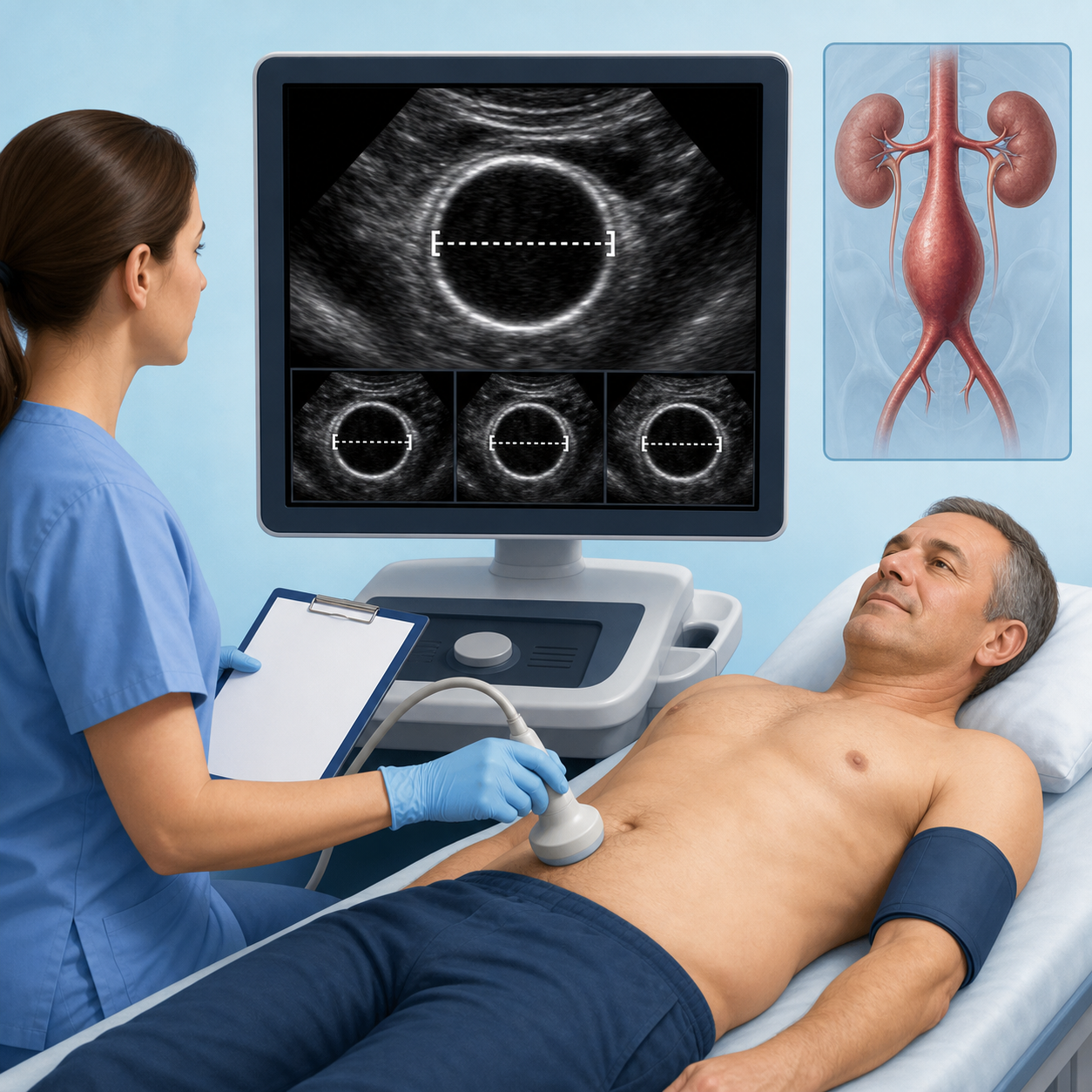
Establish a comparable baseline
Confirm maximum diameter, anatomy, and measurement method, and review symptoms and local surveillance criteria stratified by sex and diameter.
Obtain consistent imaging at scheduled intervals
Repeat ultrasound with the same institution and method when possible, using CT when needed to clarify a discrepancy or plan repair.
Reassess repair criteria at every visit
Adjust the interval according to diameter, growth, symptoms, sex, and systemic risk while continuing smoking cessation and cardiovascular risk management.
Enter repair assessment near a threshold
If related symptoms, rapid growth, or a local threshold is reached, obtain timely CT and vascular-team assessment rather than continuing routine ultrasound at the old interval.
This is a surveillance pathway lasting years and sometimes for life, until the person is no longer a repair candidate, enters a repair pathway, or surveillance ends for another reason. Every result must be reviewed by a clinical team.
Cost Information
Cost Estimate for Abdominal aortic aneurysm ultrasound surveillance and risk management
What's Included
Costs are quoted in Chinese yuan (RMB). For full self-payment without Chinese medical insurance, distinguish a single abdominal aortic ultrasound from an annual surveillance package with physician review. The quotation should itemize ultrasound, the formal report, vascular-specialist review, risk-factor management, and the planned number of follow-up examinations. Contrast-enhanced CT, kidney-function testing, or shorter surveillance intervals should be quoted separately.
Before Your Visit
What to Prepare
Required Tests & Examinations
If you already have recent valid test results, bring the reports. If not, these assessments can usually be completed in China before the procedure.
Confirm the maximum abdominal aortic diameter and measurement method by ultrasound or CT and compare previous original images to determine growth.
Assess symptoms, smoking, blood pressure, lipids, family history, sex, kidney function, life expectancy, and physical fitness for possible future repair.
Confirm whether the AAA is infrarenal and whether iliac or thoracic aortic disease, connective-tissue disease, or another condition may alter routine thresholds and surveillance.
Documents & Materials to Bring
Required to Bring
All previous original ultrasound or CT images and reports, exact examination dates, and measurement methods.
Blood-pressure and medication records, smoking status, family history, and information on other aortic or connective-tissue disease.
A surveillance plan stating the next imaging date, symptoms that trigger earlier assessment, and contact details for the responsible team.
Companion & Support
A companion is usually unnecessary but may help with communication, mobility, or remembering instructions when needed.
After Treatment
Recovery & Follow-Up
Do not skip later examinations because the diameter was stable once; the team must interpret differences between imaging measurements.
Smoking cessation and blood-pressure and lipid management mainly reduce overall cardiovascular risk and do not replace aneurysm imaging.
Sudden persistent severe abdominal or back pain, fainting, cold sweat, and low blood pressure may indicate rupture. Call emergency services immediately rather than traveling independently for routine ultrasound.
Follow-Up Schedule
Schedule according to individual diameter, sex, growth, and local guidance. New persistent abdominal or back pain needs prompt assessment; sudden severe pain with fainting or low blood pressure requires immediate emergency response.
Related Conditions
Conditions This Procedure Treats
Ready to Plan Abdominal aortic aneurysm ultrasound surveillance and risk management in China?
Let Carevia help you find the right hospital, coordinate your treatment, and arrange every detail of your medical trip.
Frequently Asked Questions
Need personalized guidance?
Our care coordinators can help you assess whether this procedure fits your situation.
Contact Us