Strabismus Correction Surgery (Eye Muscle Surgery)
The attachment points or effective lengths of one or more extraocular muscles are surgically adjusted to rebalance the forces on the globe, aligning the eyes in all positions of gaze to restore binocular visual function and improve appearance.
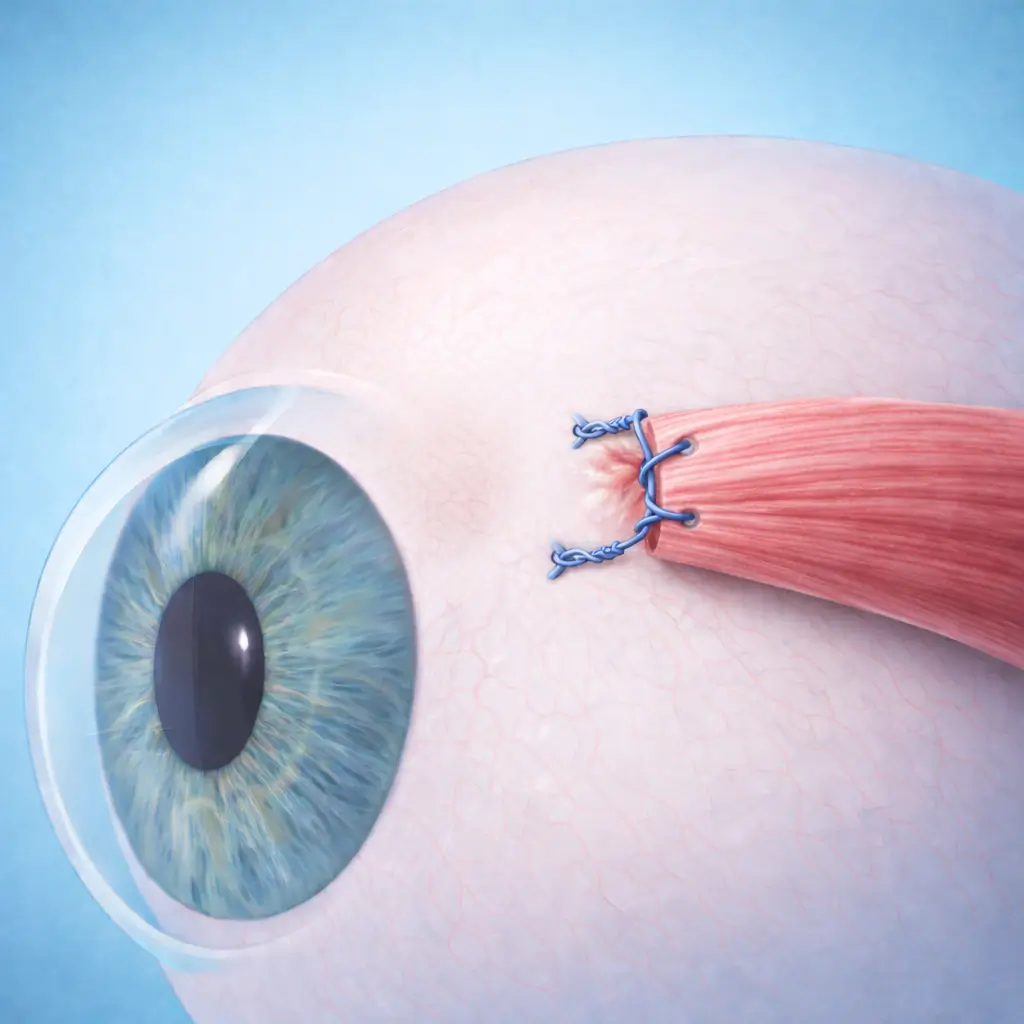
Strabismus correction surgery repositions the attachments or alters the lengths of the six extraocular muscles (medial and lateral rectus, superior and inferior rectus, superior and inferior oblique) to balance their respective pulling forces on the globe, achieving ocular alignment that restores binocular vision, eliminates diplopia, and improves cosmesis. The principal surgical techniques are: weakening procedures (recession — the muscle insertion is detached and reattached posterior to the original site, reducing its mechanical advantage) and strengthening procedures (resection — a segment of muscle is excised to shorten and increase its force; or advancement — moving the insertion anteriorly). Horizontal strabismus (esotropia, exotropia) is addressed with medial and lateral rectus recessions and resections; vertical and torsional strabismus requires vertical rectus or oblique muscle surgery. Surgery is performed under local anesthesia with or without sedation in cooperative adults, and under general anesthesia in children and uncooperative patients. Adjustable suture technique is a major advance for adult strabismus — sutures are tied in a bow-tie slip-knot and adjusted postoperatively once the patient is alert and cooperative (typically 4-6 hours after surgery), allowing fine-tuning of the final eye position and significantly improving surgical accuracy, particularly for paralytic strabismus or residual deviation. For children, early surgery during the visual developmental sensitive period (generally before age 8) is important for establishing normal binocular vision. In adults, the primary goals are diplopia elimination and cosmetic improvement; restoration of full binocular stereopsis is more limited.
Quick Reference
Treatment
30 mins – 1.5 hours
Observation
2 hours – 8 hours
Est. Cost
$1,900 – $6,600
Department
Ophthalmology
Who Is This For
Is Strabismus Correction Surgery (Eye Muscle Surgery) Right for You?
Good Candidates
- Any type of strabismus (esotropia, exotropia, vertical deviation) that remains outside normal alignment after conservative management (spectacles, amblyopia treatment)
- Childhood strabismus — especially esotropia — where early surgery is crucial for binocular visual development
- Adult strabismus causing diplopia that interferes with daily life or work
- Strabismus persisting after completion of amblyopia treatment
- Cosmetically bothersome strabismus (even without functional diplopia) at patient's request
May Not Be Suitable
- Strabismus of unclear etiology requiring further neurological or systemic investigation (e.g., acute-onset paralytic strabismus — CNS cause must be excluded first)
- Fully accommodative esotropia (completely corrected by spectacles — surgery is not indicated)
- Amblyopia treatment not yet completed in children (amblyopia should be treated to near-normal vision before surgery)
- Active ocular infection
- Systemic condition precluding anesthesia (pediatric general anesthesia risk requires medical clearance)
Step-by-Step Process
How Strabismus Correction Surgery (Eye Muscle Surgery) Works
Anesthesia
Children receive general anesthesia (laryngeal mask or endotracheal intubation). Adults may have retrobulbar block or general anesthesia; patients planned for adjustable sutures require retained alertness for postoperative cooperation (local anesthesia with IV sedation during surgery).
Conjunctival Incision and Muscle Isolation
A conjunctival incision is made at or near the limbus adjacent to the target muscle. Blunt dissection exposes the muscle belly. A strabismus hook isolates the full muscle width; 6-0 absorbable locking sutures are placed on each side before the muscle is disinserted from the sclera.
Muscle Procedure
Recession: the disinserted muscle is reattached to the sclera at the calculated number of millimeters posterior to its original insertion. Resection: the calculated length of muscle tissue is excised from the proximal end; the shortened muscle is reattached at or anterior to the original insertion. Oblique surgery: the oblique muscle is tenotomized, transposed, or tucked as required.
Adjustable Suture Placement (when indicated)
The muscle suture is temporarily fixed to the sclera with a bow-tie slip-knot and the conjunctiva closed with the suture tails accessible externally. Four to six hours postoperatively, when the patient is alert and cooperative, the surgeon evaluates alignment at the slit lamp and slides the slip-knot to fine-tune the muscle position before converting to a permanent square knot.
Conjunctival Closure and Completion
The conjunctiva is closed with absorbable sutures. Subconjunctival antibiotic and steroid are injected; antibiotic ointment and an eye pad are applied. General anesthesia patients are transferred to the recovery suite; local anesthesia patients are observed for 2-4 hours.
Most cases require a single surgical procedure. Complex strabismus (paralytic strabismus, very large angles) may require two or more staged procedures. Postoperative antibiotic + steroid drops are used for 4-6 weeks.
Cost Information
Cost Estimate for Strabismus Correction Surgery (Eye Muscle Surgery)
Estimated Price Range
$1,900 – $6,600
What's Included
Public tier-3A International Medical Department: pediatric strabismus (1-2 muscle surgery under general anesthesia, including hospitalization) approximately ¥13,000-22,000; adult strabismus (adjustable suture technique) approximately ¥15,000-25,000. Premium private eye centers: with precise strabismus measurement, individualized surgical planning, and senior strabismus specialist throughout, approximately ¥25,000-45,000, including adjustable suture services and binocular vision rehabilitation.
Before Your Visit
What to Prepare
Required Tests & Examinations
If you already have recent valid test results, bring the reports. If not, these assessments can usually be completed in China before the procedure.
Prism-cover testing in all cardinal positions (quantify deviation in prism diopters)
Binocular vision assessment (Worth four-dot test, stereoacuity testing)
Ocular motility assessment (identify limitations or over-actions in all gaze directions)
Cycloplegic refraction (exclude or quantify accommodative esotropia component)
Visual acuity and best corrected visual acuity (rule out amblyopia)
Fundus examination (exclude organic pathology)
Documents & Materials to Bring
Required to Bring
Strabismus angle measurement records (prism testing results)
Records of prior spectacle wear and amblyopia treatment
Preoperative medical evaluation for general anesthesia (pediatric patients)
Passport and valid visa
Companion & Support
A parent or guardian must be present throughout for pediatric surgery, including the anesthesia recovery period. Adult patients using adjustable sutures must wait 4-6 hours in clinic for suture adjustment and require a companion for transportation. Accompaniment to the early postoperative follow-up visits is recommended as vision may be temporarily unstable.
After Treatment
Recovery & Follow-Up
Conjunctival redness, mild swelling, and foreign-body sensation are normal and gradually resolve over 2-3 weeks
Adults may experience transient diplopia early postoperatively as binocular fusion re-establishes — this typically improves over days to weeks
After pediatric general anesthesia, monitor for emergence vomiting and aspiration risk in the recovery period
Apply prescribed antibiotic and steroid drops as directed; cold compresses reduce periocular swelling
Avoid vigorous sports and swimming for 1 month
Children should continue occlusion therapy (if amblyopia is present) and binocular vision training after surgery
Follow-Up Schedule
Day 1 (alignment check), week 1, month 1, and month 3; adjustable suture adjustment on the day of or day after surgery. Children require ongoing follow-up until visual maturity (~age 16).
Related Conditions
Conditions This Procedure Treats
Ready to Plan Strabismus Correction Surgery (Eye Muscle Surgery) in China?
Let Carevia help you find the right hospital, coordinate your treatment, and arrange every detail of your medical trip.
Frequently Asked Questions
Need personalized guidance?
Our care coordinators can help you assess whether this procedure fits your situation.
Contact Us