Back to Hospitals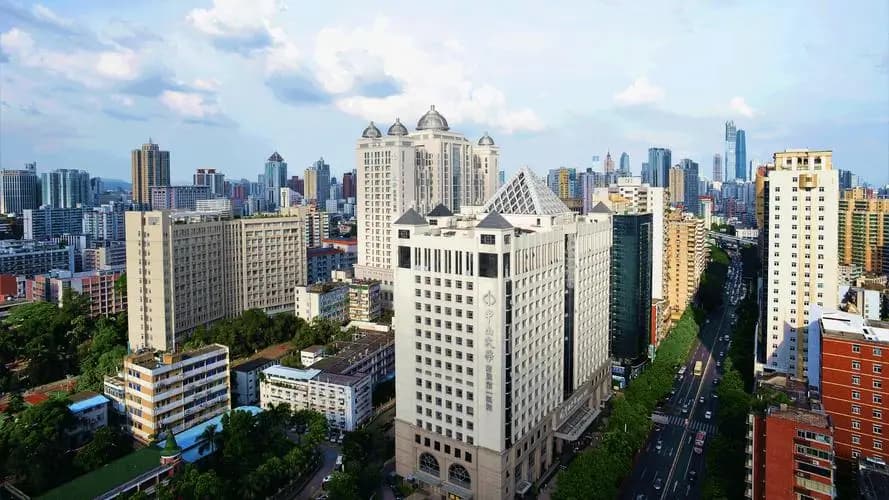
Grade III Grade A
The First Affiliated Hospital of Sun Yat-sen University
A century-old institution, dedicated to public service. The First Affiliated Hospital of Sun Yat-sen University (hereinafter referred to as "Sun Yat-sen First Hospital") was founded in 1910, evolving from the public hospital affiliated with the Guangdong Public Medical School. Adhering to the medical motto of "Healing the body, mind, and spirit; Saving lives, the nation, and the world," it has now entered the ranks of China's top-tier hospitals.
The hospital currently has the Yuexiu Main Campus, Huangpu Campus, and Nansha Campus. It has also jointly established the First Affiliated Hospital of Sun Yat-sen University Guangxi Hospital and the First Affiliated Hospital of Sun Yat-sen University Guizhou Hospital with Guangxi and Guizhou respectively, aiming to create national regional medical centers. The hospital boasts strong comprehensive strength, serving as a "mentoring" unit for the creation of a comprehensive national medical center, a pilot hospital for high-quality development of national public hospitals, a pilot hospital for establishing and improving the modern hospital management system, a construction unit for the national project to improve the diagnosis and treatment capabilities of difficult and complex diseases, a pilot unit for the national "flagship" hospital for the integration of traditional Chinese and Western medicine, the supporting unit for the National Human Tissue and Organ Transplantation and Medical Big Data Center, and one of the first batch of key construction units of high-level hospitals in Guangdong Province and a construction unit of the Guangdong International Precision Medicine Center. It has outstanding disciplinary advantages, possessing 5 national key disciplines and 36 national key clinical specialties. It has made significant contributions to the selection of basic medicine and clinical medicine of Sun Yat-sen University as "Double First-Class" disciplines and to the entry of clinical medicine into the top 0.5‰ of ESI globally. For five consecutive years, it has been rated A++ in the national performance evaluation of tertiary public hospitals. The hospital has creatively proposed a "campaign-based" approach to guide the creation of a national medical center: guided by the "Four Orientations" proposed by General Secretary Xi Jinping, implementing the Party's health and wellness work policy in the new era, adhering to the "Guiding Principles" of "strengthening talent, emphasizing basic research, promoting clinical practice, building platforms, fostering interdisciplinary collaboration, advancing translational research, and focusing on evaluation," and taking "creating a world-class national medical center" as its campaign goal. It has adopted a "6+1" campaign-based approach to high-quality development: 1) building a center for the diagnosis and treatment of complex and critical illnesses and disaster medicine; 2) building a world-class scientific and technological innovation center—a precision medicine mega-science center; 3) building a center for cultivating top-tier medical talent; 4) building a high-level international exchange and cooperation center; 5) establishing and improving a modern hospital governance system; and 6) building a scientific evaluation system for specialties and talent (ecology and culture). The hospital strives to fully build a world-class national medical center with Chinese characteristics, playing a leading, exemplary, and radiating role!
Established
1905-03-24
Official website
www.fahsysu.org.cn
Snapshot
Active departments
33 active departments available in this language.
Hospital tag
Grade III Grade A
Care planning
Need help comparing departments or travel logistics?
Carevia can help you assess department fit, shortlist hospitals across cities, and coordinate translation, appointments, and post-visit travel planning.
Departments
Clinical departments at The First Affiliated Hospital of Sun Yat-sen University
33 department profiles are available for review.
Anesthesiology
The Department of Anesthesiology at the First Affiliated Hospital of Sun Yat-sen University (hereinafter referred to as Sun Yat-sen First Hospital) was established in 1958 and developed into a clinical anesthesiology department in 1985. Past directors include: Wu Shouren, Zhou Shufen, Zhang Shangli, Chen Bingxue, and Huang Wenqi. From its initial focus on a single clinical anesthesiology field, the Department of Anesthesiology at Sun Yat-sen First Hospital has evolved into a comprehensive secondary clinical discipline with multiple sub-disciplines. Today, it is one of the most technically advanced anesthesiology departments in Guangdong Province and many other southern provinces of China, enjoying a high reputation in Hong Kong, Macau, and Southeast Asia. Currently, the Department of Anesthesiology at Sun Yat-sen First Hospital has 42 employees, including 2 professors and 5 associate professors. 85% of the anesthesiologists have obtained or are pursuing master's or doctoral degrees. Many of them have studied and trained in the United States, Europe, and Japan. Scholars are still pursuing further studies abroad. Current deputy directors of the Department of Anesthesiology are: Xiao Liangcan and Wu Changbin.
Anesthesiology
Department of Stomatology
The Department of Stomatology at the First Affiliated Hospital of Sun Yat-sen University is the largest and most comprehensively equipped department of stomatology among the six comprehensive affiliated hospitals of Sun Yat-sen University. It leverages the overall advantages of the First Affiliated Hospital while also possessing its own unique characteristics as an undergraduate specialty. The Department undertakes a significant amount of clinical, teaching, and research work in stomatology at Sun Yat-sen University.
Dentistry
Department of Oral Prosthodontics
Department introduction is not available yet.
Prosthodontics
Ophthalmology
This is a second-level medical discipline and a master's degree training center. Currently, there are 2 master's supervisors. There are 11 practicing physicians, 2 technicians, and over ten nurses. Among the physicians, there is 1 senior physician, 4 associate senior physicians, 4 intermediate-level physicians, and 2 resident physicians. The ward has 18 beds, and the general outpatient clinic sees approximately 200 patients daily. It also has 10 professor-run outpatient units and specialized outpatient clinics for plastic surgery, dry eye, strabismus and amblyopia, low vision rehabilitation, fundus diseases, and uveitis. The department is equipped with advanced A/B ultrasound, fundus fluorescein angiography, strabismus and amblyopia examination, electrophysiological examination, visual field examination, and topographic mapping, providing high-level services to patients. This discipline has a well-structured team for ophthalmic medical research and teaching, and advanced medical equipment. Clinically, it has the comprehensive ability to diagnose and treat common and severe cases, especially eye diseases accompanied by systemic diseases and complex ocular trauma. Currently, the main procedures performed include: phacoemulsification cataract surgery with intraocular lens implantation, glaucoma filtration surgery, combined glaucoma and cataract surgery, ptosis correction, double eyelid surgery, blepharoplasty and other oculoplastic surgeries, strabismus correction of various types such as comitant and paralytic strabismus, nystagmus correction, orbital tumor removal, artificial eye socket implantation, various lacrimal duct reconstruction surgeries, eye trauma repair and reconstruction, corneal transplantation and other surgeries.
Ophthalmology
Organ Transplantation Department
The First Affiliated Hospital of Sun Yat-sen University (formerly the First Affiliated Hospital of Sun Yat-sen Medical University, abbreviated as Sun Yat-sen First Hospital) is one of the most renowned large-scale comprehensive hospitals in my country, directly under the Ministry of Health. As early as 1972, Professor Mei Hua led the implementation of my country's first successful kidney transplant, making Sun Yat-sen First Hospital one of the earliest hospitals in my country to perform organ transplantation. In 1993, Professor Huang Jiefu successfully performed my country's first liver transplant under extracorporeal venous bypass, becoming the initiator and promoter of the second wave of liver transplantation in my country. In 1996, Professor Huang Jiefu and Professor Zheng Keli established the Department of Organ Transplantation at Sun Yat-sen First Hospital, becoming one of the earliest independently established organ transplant centers in my country. That same year, they jointly performed Asia's first combined liver and kidney transplant, causing a national sensation. In the same year, the hospital performed my country's first infant heart transplant. More than thirty hospitals across the country have sent technical experts to Sun Yat-sen First Hospital to observe and learn organ transplantation techniques. Sun Yat-sen First Hospital has become one of the main birthplaces of clinical major organ transplantation in my country. Professor Huang Jiefu, Honorary Director of the Department of Organ Transplantation, is a leading figure in transplantation work in my country, Chairman of the China Organ Donation Committee, and Honorary Chairman of the Chinese Society of Organ Transplantation. Professor Zheng Keli previously served as Vice Chairman of the Chinese Society of Organ Transplantation and Deputy Head of the Kidney Transplantation Group.
Liver Transplantation
Throat Specialist
The Department of Otolaryngology at the First Affiliated Hospital of Sun Yat-sen University is a national key discipline, a national key clinical discipline, a key discipline of Guangdong Province, a key specialty of the Guangdong Provincial Health and Family Planning Commission, a master's and doctoral degree training center and postdoctoral research station, a national training base for otolaryngology endoscopy, and a national training base for otolaryngology resident physicians. The current discipline leader is Professor Xu Geng, recipient of the National Science Fund for Distinguished Young Scholars and Vice Chairman of the Otolaryngology-Head and Neck Surgery Committee of the Chinese Medical Association. The hospital's president is Professor Wen Weiping, Vice President of the Otolaryngology Branch of the Chinese Medical Doctor Association. The department boasts a first-class medical, research, and teaching talent team. Since its establishment as a specialized otolaryngology hospital in 2003, the department has experienced rapid growth. It was designated a national key discipline by the Ministry of Education in 2007 and a national key clinical discipline by the Ministry of Health in 2011. Currently, it comprises four tertiary departments: Otology, Rhinology, Laryngology, and Allergy, with three independent wards and a total of 120 beds. In 2012, the average daily outpatient volume was approximately 580 visits, with 3,598 inpatient admissions and 5,180 surgeries performed. Currently, there are 96 medical staff, including 32 doctors and 2 researchers (13 senior professionals and 8 associate senior professionals). The department has established 17 professor-run outpatient clinics and specialized outpatient clinics in otolaryngology (including allergy), laryngology (including voice), and head and neck tumors. This department has now developed into the largest, most advanced, and most technically comprehensive otolaryngology medical, teaching, and research center in South my country, and has essentially laid the foundation for becoming a first-class research-oriented clinical specialty in China.
Laryngology
Rhinoplasty
The Department of Rhinology at the First Affiliated Hospital of Sun Yat-sen University currently has 37 beds and a staff of 5 professors (including chief physicians/researchers), four of whom are doctoral supervisors, and 2 associate professors. It is a national key discipline (Ministry of Education) and a national key specialty (Ministry of Health). Clinical Work: As the founding unit of endoscopic sinus surgery in China, it pioneered fields such as endoscopic sinus surgery, endoscopic nasal skull base surgery, and endoscopic nose-eye related surgery. Endoscopic surgery is at the forefront in China. The annual training courses "New Advances in Endoscopic Sinus Surgery and Research on Chronic Sinusitis" and "Endoscopic Anatomy of the Sinuses and Adjacent Regions" are the most renowned training courses in this specialty in China. 1. Endoscopic Sinus Surgery: As one of the earliest units in China to conduct endoscopic sinus surgery, it performs over 1500 endoscopic sinus surgeries annually. The surgeries performed include: endoscopic sinus surgery for chronic sinusitis, endoscopic surgery for complex chronic sinusitis, endoscopic resection of malignant tumors of the nasal cavity and sinuses, endoscopic resection of nasopharyngeal angiofibroma (stages III and IV), endoscopic repair of nasal septal perforation, and endoscopic repair of meningoencephalocele. Most of these surgeries were first reported in China.
Rhinology
ENT specialist
The Department of Otolaryngology possesses state-of-the-art hearing and electrophysiological examination instruments and surgical equipment, and boasts a top-tier academic team, including 3 professors, 3 associate professors, 2 attending physicians, and 2 resident physicians. It also houses a Clinical Hearing Center with 3 physicians specializing in clinical and research work in audiology (1 senior, 1 intermediate, and 1 junior), and 5 audiology technicians. Its overall strength has reached a leading level in the province and an advanced level nationally. Clinical work: Equipped with all modern audiological examination, screening, and diagnostic equipment and techniques, it performs various types of tympanoplasty, stapes resection, facial nerve decompression, jugular bulb tumor resection, and cochlear implantation (a Ministry of Health-designated cochlear implantation surgery unit). 1. Ear Microsurgery: Primarily performs various middle ear surgeries, including the treatment of chronic suppurative otitis media, cholesteatoma, tympanic cavity tumors, adhesive otitis media, tympanic sclerosis, hemangioma, cholesterol granuloma, and external and middle ear malformations. The department performs nearly 800 ear microsurgeries annually (including stapes surgery). 2. Endoscopic Ear Surgery: Since the early 1990s, it has pioneered endoscopic ear surgery nationwide, and has performed more than 3,000 surgeries to date, including endoscopic tympanic membrane repair, tympanotomy and tube insertion for secretory otitis media, ossicle implantation for otosclerosis, and cholesteatoma resection for epitympanic cavity exploration.
Otology
1/5