Back to Hospitals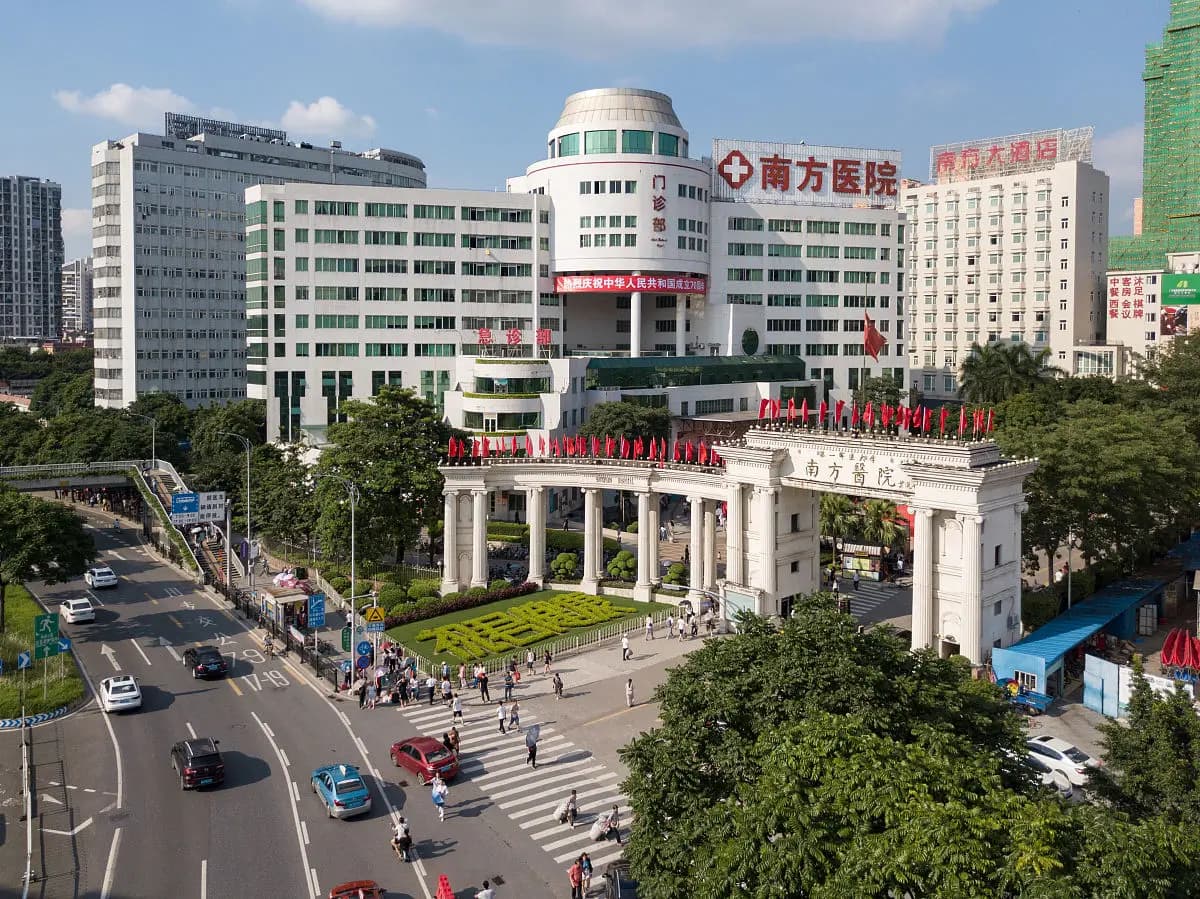
Grade III Grade A
Southern Medical University Southern Hospital
Southern Medical University Nanfang Hospital is the First Affiliated Hospital and First Clinical Medical College of Southern Medical University. It undertakes clinical medical care, medical education, medical research, and preventive healthcare tasks. It is a large-scale comprehensive tertiary-level Class A hospital and a national regional medical center. Founded in 1941, it was initially a rear hospital for the Third Division of the New Fourth Army. In 1975, its designation was changed to the First Affiliated Hospital of the First Military Medical University of the Chinese People's Liberation Army, and it was officially named "Nanfang Hospital" with the approval of the General Logistics Department. In 2004, along with the restructuring of the First Military Medical University, the hospital was transferred to Guangdong Province and renamed Southern Medical University Nanfang Hospital.
The hospital currently has its main campus and Zengcheng campus. In cooperation with the Ganzhou Municipal People's Government of Jiangxi Province, it is jointly building a national regional medical center based on Ganzhou People's Hospital (Southern Medical University Nanfang Hospital Ganzhou Branch). The hospital is currently a designated output hospital for the construction of national regional medical centers, a national trauma regional medical center jointly constructed by the provincial and national governments, a unit of the national project to improve the diagnosis and treatment capabilities of difficult and complex diseases (tumors), a national regional TCM (rheumatology) diagnosis and treatment center, a national emergency medical rescue base, a pilot project unit for the construction of a flagship hospital integrating traditional Chinese and Western medicine, a project base of the Higher Education Discipline Innovation and Talent Introduction Program ("111 Program"), and one of the first key construction units of the Guangdong Provincial High-Level Hospital "Peak Climbing Plan". It houses the National Key Laboratory for Organ Failure Prevention and Treatment, the National Clinical Research Center for Chronic Kidney Disease, as well as the Guangdong Provincial Institute of Nephrology, the Guangdong Provincial Institute of Liver Disease, the Guangdong Provincial Institute of Trauma and Orthopedics, and the Southern Institute of Digestive Diseases. The hospital has 5 national key disciplines, 17 national key clinical specialties, and 4 national key clinical specialty construction projects (neurology, anesthesiology, cardiology, and respiratory and critical care medicine). Clinical medicine and stomatology are first-level disciplines authorized to grant doctoral degrees. It boasts 1 academician of the Chinese Academy of Sciences, 7 dual-appointed academicians, and more than 60 national-level talents, including Changjiang Scholars, National Outstanding Young Scientists Fund recipients, National Excellent Young Scientists Fund recipients, and Young and Middle-aged Innovation Leading Talents of the Ministry of Science and Technology. In 2006, Academician Hou Fanfan's research findings on the prevention and treatment of chronic kidney disease were published in the *New England Journal of Medicine* (NEJM), attracting high attention from the international medical community and marking a breakthrough for mainland Chinese scholars in publishing articles in this journal. In 2019, Professor Li Guoxin's latest research findings on laparoscopic minimally invasive gastric cancer treatment were published in the *Journal of the American Medical Association* (JAMA) and included in the US NCCN guidelines. In 2022, Professor Zhang Huijie's clinical research findings on dietary intervention for obese patients were published in the *New England Journal of Medicine* (NEJM), representing the first original clinical intervention research findings in the field of metabolism from my country published in this journal to date. The hospital ranked in the A+ tier in the 2023 public hospital performance monitoring and has won 10 second-class National Science and Technology Progress Awards and 37 first-class provincial and ministerial awards. In 2024, the number of National Natural Science Foundation of China-funded projects ranked 12th nationally and second in Guangdong Province. In recent years, the hospital has consistently ranked among the top 15-20 comprehensive hospitals in China in authoritative hospital rankings, with 10-15 specialties, including nephrology, infectious diseases, plastic surgery, hematology, pathology, and gastroenterology, entering the top ten or receiving nominations nationwide.
Established
1905-04-24
Official website
www.nfyy.com/
Snapshot
Active departments
14 active departments available in this language.
Hospital tag
Grade III Grade A
Care planning
Need help comparing departments or travel logistics?
Carevia can help you assess department fit, shortlist hospitals across cities, and coordinate translation, appointments, and post-visit travel planning.
Departments
Clinical departments at Southern Medical University Southern Hospital
14 department profiles are available for review.
Rheumatism (Traditional Chinese Medicine) Treatment Center
The department's ward is located on the west side of the 9th floor of the Gastroenterology Building at Nanfang Hospital, currently with 30 beds (including 6 beds for traditional Chinese medicine treatment). The first department director was Professor Li Juan. The department has 7 members, all with master's degrees or above (4 with doctoral degrees): 1 chief physician/professor, 1 associate chief physician/associate professor, 1 attending physician, 4 resident physicians, 1 doctoral supervisor, and 2 master's supervisors. The department keeps abreast of the latest developments in rheumatology diagnosis and treatment both domestically and internationally, promotes interdisciplinary exchange and cooperation, and continuously improves the level of integrated traditional Chinese and Western medicine diagnosis and treatment for complex and critical rheumatological diseases. It has developed and improved integrated traditional Chinese and Western medicine treatment plans for multiple diseases, including rheumatoid arthritis, systemic lupus erythematosus, ankylosing spondylitis, gout, and osteoporosis. The department utilizes advanced equipment such as osteoporosis treatment beds, joint therapy devices, ultrasound-guided drug delivery systems, combined therapy devices, and multifunctional moxibustion machines as new technological means for integrated traditional Chinese and Western medicine treatments.
Traditional Chinese Medicine
Neurosurgery
The Southern Brain Center (Neurosurgery Department of Southern Hospital) is one of the earliest established neurosurgical departments in my country (established in 1958) and a key discipline in Guangdong Province. After more than forty years of development, its advanced diagnostic and treatment equipment and strong technical expertise enable it to provide modern specialized treatment for all neurosurgical diseases. The department includes centers for vascular interventional therapy, stereotactic Parkinson's disease international treatment, X-knife treatment for craniocerebral diseases, and minimally invasive epilepsy treatment. It is a leading modern neurosurgical center in China, especially in South China, with strong technical capabilities and influence. Currently, the neurosurgery department has 103 beds, 15 ICU beds, 2 full professors, 8 associate professors, and 6 attending physicians, all with master's degrees or above. It is a master's and doctoral program in neurosurgery, undertaking teaching tasks at multiple levels including doctoral, master's, undergraduate, and associate degree programs. It also serves as a training base for senior neurosurgical personnel from the military and civilian sectors. The department undertakes 10 research projects with a funding of 2 million yuan and publishes 50 research papers annually. The hospital performs over 1,500 surgeries annually, including 1,000 tumor surgeries, approximately 150 of which are malignant tumors. Around 300 cases are followed up for more than 10 years. Treatment methods for malignant tumors include all advanced techniques such as microsurgery, targeted therapy, combined chemotherapy, stereotactic radiotherapy (X-knife), interstitial radiotherapy, and sustained-release chemotherapy.
Neurosurgery
Gastroenterology
The Department of Gastroenterology at Southern Medical University (formerly the First Military Medical University) was established in the 1950s and formally became a gastroenterology specialty in 1978. Under the advocacy and leadership of Professor Zhou Dianyuan, the discipline's founder, it was the first in China to introduce rigid gastroscopy in 1955 and the first to conduct fiberoptic colonoscopy in 1973. In 1979, it was approved as a master's degree granting unit, and in 1986, it became the first doctoral degree granting unit at the First Military Medical University. In 1995, with the approval of the Central Military Commission, the PLA Institute of Gastroenterology was established, and in the same year, it was approved to recruit postdoctoral fellows. In 2001, it became one of the first batch of national key disciplines designated by the Ministry of Education. In 2010, it was rated as one of the first batch of key clinical specialties by the Ministry of Health. In 2014, the Southern Institute of Digestive Diseases was approved for establishment. In 2015, it was selected as a key discipline for high-level university development in Guangdong Province. Today, it has become a leading discipline and key medical, teaching, and research base with widespread influence in the field of gastroenterology in Guangdong Province and even nationwide.
Gastroenterology
Infectious Diseases
Founded in 1951, the Department of Infectious Diseases and Liver Disease Center (Guangdong Provincial Institute of Liver Diseases) has, through the collective efforts of generations of staff, become a comprehensive platform for clinical and translational medicine in infectious diseases and liver diseases, integrating medical treatment, teaching, research, and prevention. It has long undertaken important national tasks in infectious disease prevention and control, healthcare, medical talent training, and scientific research. Its academic standing and overall strength rank among the top in the country, with medical services based in South China, serving the whole country, and radiating to Southeast Asia and even the world. The department has its own independent clinical building, equipped with advanced intensive care units, ultrasound rooms, and follow-up rooms, forming a distinctive medical approach that combines clinical practice with research, and clinical bases with laboratory testing. Clinically, it has 165 specialized beds, divided into three wards: a ward for complex infections (fever), a liver center ward, and a liver tumor ward. The annual outpatient volume is nearly 200,000 visits, and the number of discharged patients is approximately 8,000. Currently, the department serves as a critical care center for infectious diseases, an expert alliance for AIDS-related lymphoma, a comprehensive AIDS service center, and a diagnostic and treatment base for bacterial and fungal infections. It has achieved a leading level in China in minimally invasive diagnosis and interventional treatment of portal hypertension in cirrhosis, management of critical liver diseases, individualized diagnosis and treatment of fatty liver disease, and multidisciplinary diagnosis and treatment of liver cancer.
Internal Medicine
Gynecology
The Department of Obstetrics and Gynecology at Nanfang Hospital, Southern Medical University, was formerly the Center for Eugenics and Childbirth Technology of the Chinese People's Liberation Army. After its transfer to local administration in 2004 along with the university, it continued to develop and improve, and has now become a comprehensive discipline with multiple technological supports. It has formed its own characteristics and advantages in perinatal medicine, reproductive medicine, genetic counseling, comprehensive diagnosis and treatment of gynecological diseases such as tumors, laparoscopic and hysteroscopic minimally invasive surgery, and vascular interventional therapy, achieving an advanced academic level. In 2008, it was recognized as a key medical specialty in Guangdong Province during the "Eleventh Five-Year Plan" period. The department currently has over 100 beds, performs over 2,500 surgeries annually, and sees over 100,000 outpatients annually. In addition to traditional wards, it also has a VIP ward for overseas Chinese and obstetrics and gynecology, and a technologically advanced prenatal diagnostic center. The department has over 100 medical staff, including 20 professors/associate professors, 5 doctoral supervisors, 5 master's supervisors, and 7 expert professors who have studied in Japan, Europe, the United States, Singapore, and other countries.
Gynecology
Obstetrics
The Department of Obstetrics and Gynecology at Nanfang Hospital, Southern Medical University, was formerly the Center for Eugenics and Childbirth Technology of the Chinese People's Liberation Army. After its transfer to local administration in 2004 along with the university, it continued to develop and improve, and has now become a comprehensive discipline with multiple technological supports. It has formed its own characteristics and advantages in perinatal medicine, reproductive medicine, genetic counseling, comprehensive diagnosis and treatment of gynecological diseases such as tumors, laparoscopic and hysteroscopic minimally invasive surgery, and vascular interventional therapy, achieving an advanced academic level. In 2008, it was recognized as a key medical specialty in Guangdong Province during the "Eleventh Five-Year Plan" period. The department currently has over 100 beds, performs over 2,500 surgeries annually, and sees over 100,000 outpatients annually. In addition to traditional wards, it also has a VIP ward for overseas Chinese and obstetrics and gynecology, and a technologically advanced prenatal diagnostic center. The department has over 100 medical staff, including 20 professors/associate professors, 5 doctoral supervisors, 5 master's supervisors, and 7 expert professors who have studied in Japan, Europe, the United States, Singapore, and other countries.
Obstetrics
Department of Stomatology
The Stomatology Center of Nanfang Hospital is one of the top-ranked stomatology departments in comprehensive hospitals in China in terms of scale and academic strength. It ranks first in South China in the national ranking of stomatology departments among comprehensive hospitals. It boasts a national key clinical specialty, four national standardized training bases for stomatological residents, and a first-level doctoral degree authorization point. Currently, it comprises Outpatient Area 1, Outpatient Area 2, the Huiqiao Building Specialist Clinic, and the Oral-Head, Neck, and Maxillofacial Surgery Ward. It has 78 dental chairs, 100 beds, and sees over 130,000 outpatients annually.
Dentistry
Hematology
The Institute of Hematology, Southern Medical University, is a permanent institution within the institute. The department currently comprises four parts: a routine treatment ward, a hematopoietic stem cell transplantation ward, the Huiqiao Building ward, and the Key Laboratory of Hematology, Southern Medical University. The routine treatment ward has 102 beds, the hematopoietic stem cell transplantation ward has 34 beds, and the Huiqiao Building ward has 16 beds. The hematology laboratory has a usable area of 500 square meters and includes laboratories for immunology, cytogenetics, molecular biology, cell morphology, and a database of leukemia samples and data. Personnel: The department has 140 medical, nursing, and technical staff, including 34 physicians (13 of whom hold senior professional titles), 14 technical staff, and 91 nurses. All physicians hold master's degrees or higher, and 13 have overseas study experience. There are 4 doctoral supervisors and 5 master's supervisors. Two staff members serve as vice chairpersons of national-level academic societies, and five serve as standing committee members. Four staff members serve as chairpersons of provincial-level academic societies, and five serve as vice chairpersons.
Hematology
1/2